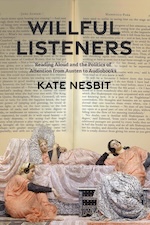

Today, we are happy to bring you our conversation with Kate Nesbit, author of Willful Listeners: Reading Aloud and the Politics of Attention from Austen to Audiobooks
What inspired you to write this book?
In a way, this book project began back when I was in high school, when I developed vocal cord nodules while rehearsing for a starring role in my school’s musical (the horror, the horror!). I had to go on complete voice rest for two weeks and communicate only by Magna Doodle. Though this was a certain kind of social torture, it did make me think in new ways about voice and about listening—especially about listening as an active, willful but often intractable process.
When I began studying reading aloud as a nineteenth-century cultural habit in graduate school, I then found myself always curious about the book’s listeners: what we might glean about their habits of attention and inattention, and what they might teach us about reading and literature in the Victorian period.
What did you learn and what are you hoping readers will learn from your book?
I learned that hearthside reading aloud, which we tend to think of nostalgically as a uniformly cherished ritual, was also a contentious and often resented practice. It was a ritual that represented cultural dictates that many found constricting. For example, when Florence Nightingale describes listening to reading aloud as a kind of torture (like having “liquid poured down one’s throat”) she is criticizing the intellectual constraints imposed on women, who must gain their education primarily by listening to books selected by others. When Thomas Hardy complains about “family reading” in his essay on “Candour in English Fiction,” he is really complaining about how fiction writers had to censor their novels for young women readers. As an ideologically-loaded cultural talisman, the hearthside reading circle became a site through which Victorians would argue about some of the most pressing issues of their time.
What surprised you the most in the process of writing your book?
One surprising finding was that many of the literary texts I analyzed used listening (rather than “voicing” or “storytelling”) as the primary metaphor for narration. Their narrators were portrayed not as captivating storytellers but rather as careful listeners and eavesdroppers, reporting back on what they’d heard and overheard. In other words: I set out to research and analyze listeners in scenes and occasions of reading aloud, but in doing so, I ended up noticing something else, too: that listening also proved a key narratological strategy and thematic preoccupation for the writers I studied.
What’s your favorite anecdote from your book?
My book’s epilogue discusses the history of the first audio books, the “talking books” recorded on wax cylinders for British veterans blinded in the First World War. The most likely candidate for the first British audio book (according, at least, to Matthew Rubery’s research on this history) is Agatha Christie’s The Murder of Roger Ackroyd. To my knowledge, no one has noted the coincidence that the twist of Christie’s novel relies on a hidden Dictaphone—the very same device that the creators of the “talking book” used to develop the first recorded novels.
I also enjoyed reading the reports of charitable scripture readers, who would visit working-class cottages to read the Bible aloud and convince the cottagers to come to church. The reports often included accounts of the working-class cottagers who would simply refuse to listen: they would fall asleep, zone out, or claim they understood perfectly but then pay absolutely no attention. Willful listeners!
What’s next?
I’m currently in the early stages of a book project on Victorian “alerts”: everyday sonic notifications like door-bells, servant bells, alarm clocks, tea kettles, etc. I hope to consider the historical origins of our current “crises of notification,” so to speak, and think through how nineteenth-century notification culture changed the rhythms of daily life—and the rhythms of the period’s poetry and prose.