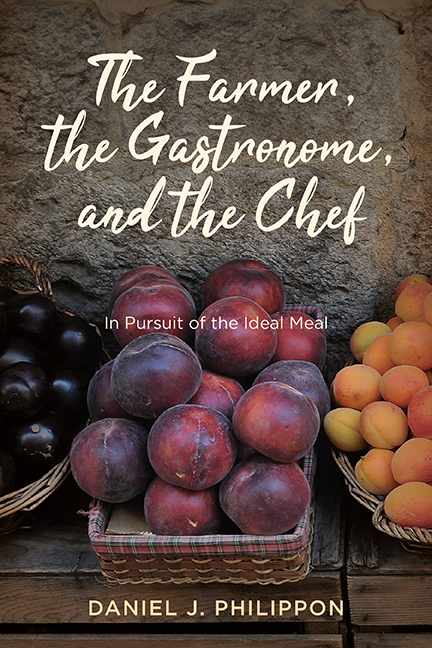
The Farmer, the Gastronome, and the Chef
In Pursuit of the Ideal Meal
Daniel J. Philippon
subjects:
The role of food writing in the sustainable food movement
At turns heartfelt and witty, accessible and engaging, The Farmer, the Gastronome, and the Chef explores how Wendell Berry, Carlo Petrini, and Alice Waters have changed America’s relationship with food over the past fifty years. Daniel Philippon weighs the legacy of each of these writers and activists while planting and harvesting vegetables in central Wisconsin, speaking with growers and food producers in northern Italy, and visiting with chefs and restaurateurs in southeastern France. Following Berry, Petrini, and Waters in pursuit of his own “ideal meal,” Philippon considers what a sustainable food system might look like and what role writing can play in making it a reality. Warning of the dangers of “agristalgia,” Philippon instead advocates for a diverse set of practices he calls “elemental cooking,” which would define sustainable food from farm to table, while also acknowledging the importance of seeking social justice throughout the food system. A rigorous yet generous appraisal of three central figures in the sustainable food movement, The Farmer, the Gastronome, and the Chef demonstrates how the written word has the power to change our world for the better, one ideal meal at a time.
These are three of the most interesting people in the world, and so it is no wonder that their stories intertwine and ricochet in fascinating ways. A book to be savored by the woodstove, a glass of local beer in hand!- Bill McKibben, American environmentalist and author of Deep Economy: The Wealth of Communities and the Durable Future
If you want to understand some of the most contentious debates around food and farming over the past fifty years, you’ll need to spend time thinking about Wendell Berry, Carlo Petrini, and Alice Waters. And you’ll want to do it in the company of Daniel Philippon, whose assured research, pointed biography and generous reflections will help make delicious sense of it all. There’s no better way to approach these three figures than in the company of a gastronaut par excellence.- Raj Patel, author of Stuffed and Starved: The Hidden Battle for the World Food System, Raj Patel, author of Stuffed and Starved
- Food and FoodwaysTraveling along this journey with Philippon is enjoyable and revelatory. His writing gives the impression of casual accessibility, but the structure is tight and the words are carefully chosen. ... The book will appeal widely, to scholars and students of food studies, environmental history, and ecocriticism, as well as curious nonacademic readers interested in sustainable food.
Philippon offers readers a new type of book: a personalized, moving, and engaging literary analysis of the writings that created the sustainable food movement alongside a consideration of the implications of that body of work for all of us. This book offers some ideal meals, but it delivers myriad capacious feasts.- Rochelle Johnson, College of Idaho, author of Passions for Nature: Nineteenth-Century America's Aesthetics of Alienation
Philippon does a great job making a case for why food literature matters and demonstrates that nonfiction is indeed literature, with its own rhetorical pitches and strategies. His accessible and witty writing style is an absolute joy.- Catherine Keyser, University of South Carolina, author of Artificial Color: Modern Food and Racial Fictions
Philippon concludes that “the ideal meal” is not so much about the end product but the practices that yielded its creation: “practice makes the world,” he says. To that point, my heavily underlined copy of The Farmer, the Gastronome, and the Chef is likely to become dog-eared as well.- Lynn Fantom, Civil Eats 2024 Food and Farming Holiday Gift Guide
The book contains all the right ingredients. . . . Philippon marries humor, careful description, and colorful dialogue with serious scholarship. . . . Readers coming to the end of this engaging work will leave with a new understanding of food traditions from farm to table and the complexities inherent in all aspects of this practice.- ISLE: Interdisciplinary Studies in Literature and Environment
Daniel J. Philippon is Associate Professor of English at the University of Minnesota, Twin Cities, and the author of Conserving Words: How American Nature Writers Shaped the Environmental Movement.
Preface
Introduction
The Farmer: Reading Wendell Berry in Wisconsin
The Gastronome: Reading Carlo Petrini in Italy
The Chef: Reading Alice Waters in France
Conclusion: Practice Makes the World
Works Cited
Introduction
The Farmer: Reading Wendell Berry in Wisconsin
The Gastronome: Reading Carlo Petrini in Italy
The Chef: Reading Alice Waters in France
Conclusion: Practice Makes the World
Works Cited

