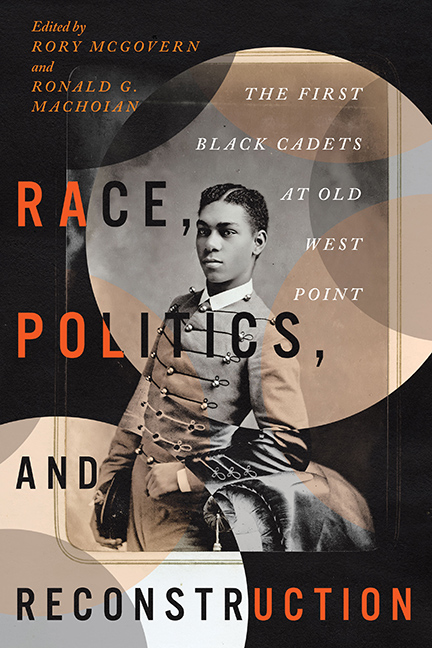
Race, Politics, and Reconstruction
The First Black Cadets at Old West Point
Edited by Rory McGovern and Ronald G. Machoian
The first in-depth study of racial integration at West Point after the Civil War
Race, Politics, and Reconstruction tells the story of racial integration at the United States Military Academy after the Civil War and spotlights the social environment and cultural currents that led to its failure. The first attempt to racially integrate West Point proved not simply a lost opportunity but an opportunity sabotaged with shocking degrees of forethought and deliberation.
By investigating West Point’s experience with race from varied and nuanced perspectives, including those of the first Black cadets, the US Army officer corps, white cadets, the Academy’s faculty and staff, and the Black and white American publics, the contributors to this volume cast both the promise and the failure of integration at West Point as an illuminating microcosm of Reconstruction itself.
Contributors: Jonathan D. Bratten, Army National Guard * Makonen A. Campbell, United States Military Academy * Adam H. Domby, Auburn University * Le’Trice Donaldson, Auburn University * Louisa Koebrich, US Army North * Ronald G. Machoian, University of Wisconsin-Madison * Cameron McCoy, US Naval War College * Rory McGovern, United States Military Academy * Amanda M. Nagel, US Army Command and General Staff College
A tour de force. The best book yet written on African American history at West Point. Race, Politics, and Reconstruction brilliantly and evocatively places integration into the broader context of post-Civil War American society, helping us understand not only West Point, but America itself.- Ty Seidule, Professor Emeritus of History at West Point, author of Robert E. Lee and Me: A Southerner's Reckoning with the Myth of the Lost Cause
A formidable collection and a nationally significant case-study that takes inventory of how social change happened in Reconstruction America. The authors powerfully demonstrate how the racial politics of Reconstruction found articulation in the everyday lives of West Point's Black cadets.- Brian Matthew Jordan, Sam Houston State University, co-editor of Final Resting Places: Reflections on the Meaning of Civil War Graves
Rarely does an essay collection so clearly demonstrate the value of this genre. In a series of outstanding essays examining the post-Civil War trials of African American West Point aspirants, scholars place the fate of these men within the broader context of Black Americans’ efforts to make their freedom meaningful in the face of white Americans efforts to deny them citizenship.- Barbara A. Gannon, University of Central Florida, author of The Won Cause: Black and White Comradeship in the Grand Army of the Republic
- The Journal of African American HistoryRace, Politics, and Reconstruction is an excellent perspective on Reconstruction’s failure . . . The collected works successfully demonstrate the irreconcilable social chasm of the time, wherein the seemingly assured fulfillment of the founders’ promise was lost after the disappearance of political will amid the lingering animosities left by the Civil War.
- The Army Historical Foundation[The contributors] reveal how the U.S. Military Academy’s struggle with integration mirrors the broader successes and failures of Reconstruction. It is remarkable that this important story has not been fully explored before now . . . Collectively, these essays paint a vivid portrait of national trauma, dissecting the complex intersection of race, politics, and Reconstruction through the lens of West Point. The Academy serves as both a battleground and a reflection of a broader struggle—one that promoted Black equality while simultaneously failing to fully realize it. Two defining themes emerge throughout the work: first, black Americans viewed military service as a crucial step toward genuine social equality; second, many white Americans, including those in the North, distinguished black freedom from true equality, believing that one did not necessarily lead to the other.
Rory McGovern is Associate Professor of History at the United States Military Academy. Ronald G. Machoian is Associate Dean in the International Division at the University of Wisconsin–Madison.

