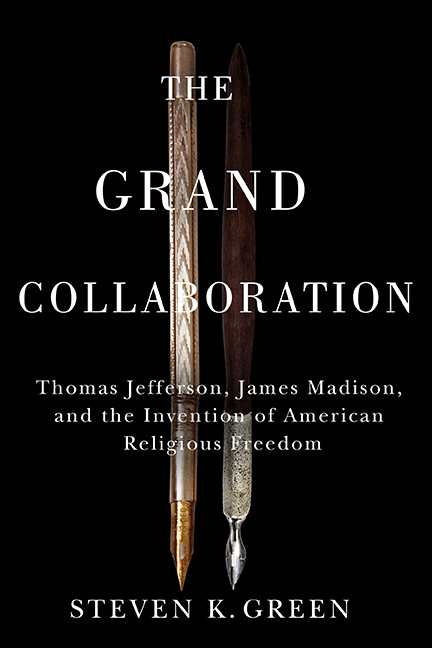
The Grand Collaboration
Thomas Jefferson, James Madison, and the Invention of American Religious Freedom
Steven K. Green
subjects:
How Jefferson and Madison ensured religious freedom in the United States
Thomas Jefferson considered the establishment of religious freedom as a governing principle in the United States to be one of the great accomplishments of his life. It was not his accomplishment alone, however, but the result of sustained cooperation with the “father of the Constitution,” James Madison. The Grand Collaboration is the first comprehensive study of Jefferson and Madison’s mutual endeavor to ensure free inquiry, freedom of conscience, and the separation of church and state, examining their fifty-year partnership beginning with the Virginia Declaration of Rights and culminating with the founding of the University of Virginia as the nation’s first truly secular institution of higher education. In an era of increasing concern with the “original intentions” of the founding generation, Steven Green, one of our great authorities on the concept and history of religious freedom, represents the best possible guide to these complex, critical issues—issues that continue to confront our society in the twenty-first century.
Green is one of the leading historians of the development of the ideas, doctrines, and practices of American religious freedom. I cannot think of another scholar who has contributed as much to the subject, and The Grand Collaboration illustrates why Jefferson and Madison remain so essential to our interpretations of issues of separation of church and state.- Jack N. Rakove, Stanford University, author of Beyond Belief, Beyond Conscience: The Radical Significance of the Free Exercise of Religion
With characteristic lucidity and insight, Steven Green has produced a superb account of the intellectual partnership between Jefferson and Madison that birthed the nation’s modern conception of religious freedom. This gripping history details the nuance and care that went into the foundational documents laying out the matrix of religious liberty along with the long judicial wrangling that has led to the erosion of this precious ideal in recent decades. The prescience of both men in foreseeing the dangers to the American experiment posed by what we now term Christian nationalism is chastening, as we see strikingly similar political battles taking place over religious freedom today. An urgent must-read for our time.- R. Marie Griffith, Washington University in St. Louis, author of Making the World Over: Confronting Racism, Misogyny, and Xenophobia in U.S. History
- Journal of Southern History[Green] builds a compelling case for the importance of religious freedom to the country and the importance of these two men for defining and defending its contours. While every state in the Union was transforming its relations between church and state after the Revolution, no transformation was as remarkable as Virginia's. In a single decade, Virginia progressed from having 'the most entrenched and intolerant religious establishmen'" of any state to boasting 'the highest degree of religious freedom in human history' (p. 66). And this transformation was owing almost entirely to Jefferson's Bill for Establishing Religious Freedom (passed in 1786), combined with Madison's Memorial and Remonstrance Against Religious Assessments (1785) and political acumen.
Steven K. Green is the Fred H. Paulus Professor of Law and Affiliated Professor of History and Religious Studies at Willamette University and the author of Separating Church and State: A History.

