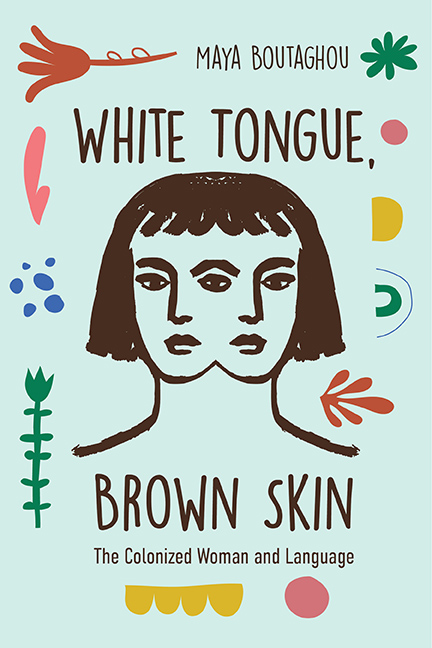
White Tongue, Brown Skin
Examines the effect of prescribed multilingualism as expressed by women writers in colonial contexts
What does it mean to be an heir, as a woman writer, to colonial and postcolonial cultures in which European language has become so thoroughly ingrained? Examining women writers from India (Toru Dutt), Egypt (Mayy Ziyadah), Algeria (Assia Djebar), and Mauritius (Ananda Devi), White Tongue, Brown Skin sheds light on the essential double nature of the colonial experience.
Maya Boutaghou’s latest book—her first in English—treats colonialism as analogous to a disease, manifesting itself in symptoms of multilingualism and cultural pluralism. Boutaghou shows how violently imposed multilingualism engenders in the mind of the colonized subject a state of permanent self-translation between two or more languages with unequal political and emotional power. They must endure a plural perception of the self, defined by the restless movement of self-translation, which becomes reflected in a literary dynamic frequently overlooked or misunderstood by previous scholarship.
Although the object is philosophical, this book is also deeply rooted in history. Understanding postcolonialism from below, as Boutaghou demonstrates, starts with an approach based on close readings in specific historical contexts.
An intelligent study of four women writers’ ambivalent relationship with colonial language. Boutaghou demonstrates how the colonial situation can also generate creative forms of language usage with her close readings, showing how two languages can be operative within the text in ways not necessarily visible at first glance.- Jane Hiddleston, Exeter College, Oxford, author of Writing After Postcolonialism: Francophone North African Literature in Transition
A substantial and highly original book. The concentration in this study on translation, multilingualism, and cosmopolitanism in colonial and postcolonial contexts is particularly striking in its attention to the implications for women who express themselves in writing as well as in its evocations of sonorous elements that work their way into the written narrative.- Alison Rice, University of Notre Dame, author of Worldwide Women Writers in Paris: Francophone Metronomes
- CHOICEThis well-researched book relies on rich critical theoretical approaches: its discussion of multilingualism, multiculturalism, and cosmopolitanism within colonial and postcolonial contexts is insightful. It is accessible to college students and would serve as an excellent reference on longstanding themes of identity, women, language and translation, colonization, and postcolonialism, among others.
- H-FranceGrants readers important insights into the relationship between multilingualism and women writers of the colonial and postcolonial world. . . [it] is a well-written, detailed analysis that confirms that the multilingual experience is not only central to postcolonial subjectivity and identity but encourages colonial/postcolonial writers to rethink their relationship to the European languages embodying the legacy of colonialism.

