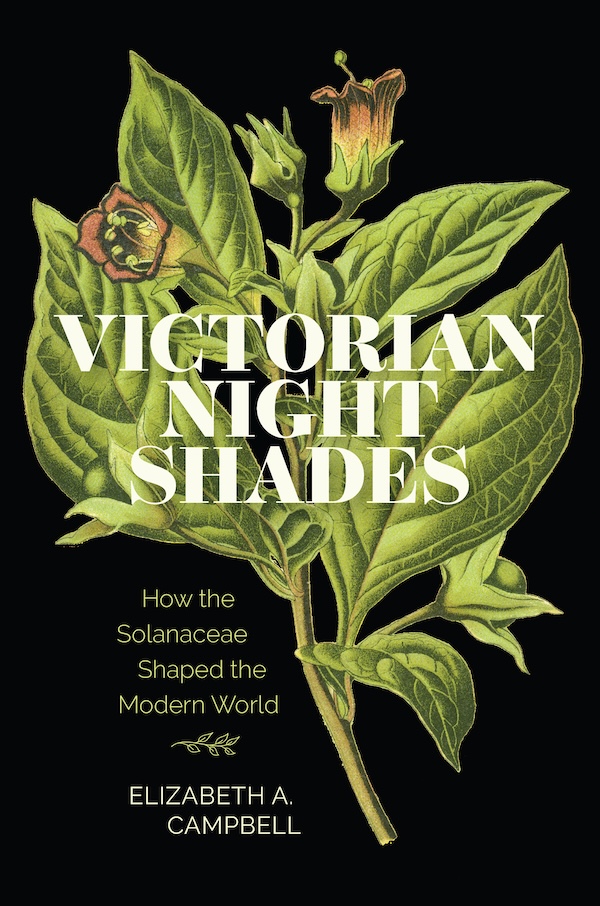
Victorian Nightshades
How the Solanaceae Shaped the Modern World
Elizabeth A. Campbell
A darkly alluring plant family and the arrival of modernity
Victorian Nightshades tells the story of how one plant family—notorious for centuries in England because of its frequently psychoactive and poisonous properties—rose to social and economic prevalence during the nineteenth century. Beginning with bittersweet and belladonna, the Old World species associated with evil, witchcraft, and dangerous women in an era when traditional botanical beliefs not only assigned morality to plants but also gendered them, Campbell then moves to the ubiquitous potato and tobacco before concluding with four of the Solanaceae that achieved the widest national favor by the end of the century: the ornamental petunia and the edible pepper, eggplant, and tomato.
The story of the nightshades exposes the conflicts between science and popular sentiment and between knowledge and received opinion that defined the nineteenth century. Campbell compellingly details how advances in medical and botanical knowledge, evolutionary theory, and the vagaries of human desire transformed the Solanaceae from a plant family plagued by fear and hostility in the British imagination to one of cultural favor and celebration by the turn of the century—encapsulating the Victorian era’s course to modernity.
A deeply learned and researched, original, and fascinating study. How does a plant family, which had historically been understood through a lens of fear and hostility, get transformed into one of cultural predominance? This book shows how plants—here, tobacco, potatoes, petunias, belladonna as medicine—gave birth to many of the features of the modern moment.- Amy King, St. John's University, author of Bloom: The Botanical Vernacular in the English Novel and The Divine in the Commonplace: Reverent Natural History and the Novel in Britain.
- H-EnvironmentCampbell’s discussion of Solanaceae is erudite and wide-ranging—it touches on such topics as Charles Darwin, picturesque aesthetics, witchcraft, and glass technologies—and although the book operates in the same general vein as Mark Kurlansky’s Salt: A World History (2002), Jack Turner’s Spice: The History of a Temptation (2005), and other more journalistic object microhistories, it’s distinctive in its literary-critical commitment to evaluating references to Solanaceae in all manner of texts, including botanical treatises, newspaper reports, and medical advertisements, as well as poetry and fiction.
- The Canadian Field-NaturalistThe Canadian Field-Naturalist
Elizabeth A. Campbell is Professor Emerita in the School of Writing, Literature, and Film at Oregon State University and the author of Fortune’s Wheel: Dickens and the Iconography of Women’s Time.
List of Illustrations
Acknowledgments
1. A Family Plot
2. Bittersweet: The Climbing Nightshade
3. Dulcamara: Affairs and Elixirs of Love
4. Belladonna: The Deadly Nightshade
5. Victoria's Secrets: Sex, Drugs, and Belladonna
6. The Triumph of the Potato
7. Sublime Tobacco: Now Let Us Praise the Deadliest Nightshade
8. Back to the Garden: Petunias, Peppers, Eggplants, and Tomatoes
Notes
Bibliography
Index
Acknowledgments
1. A Family Plot
2. Bittersweet: The Climbing Nightshade
3. Dulcamara: Affairs and Elixirs of Love
4. Belladonna: The Deadly Nightshade
5. Victoria's Secrets: Sex, Drugs, and Belladonna
6. The Triumph of the Potato
7. Sublime Tobacco: Now Let Us Praise the Deadliest Nightshade
8. Back to the Garden: Petunias, Peppers, Eggplants, and Tomatoes
Notes
Bibliography
Index

