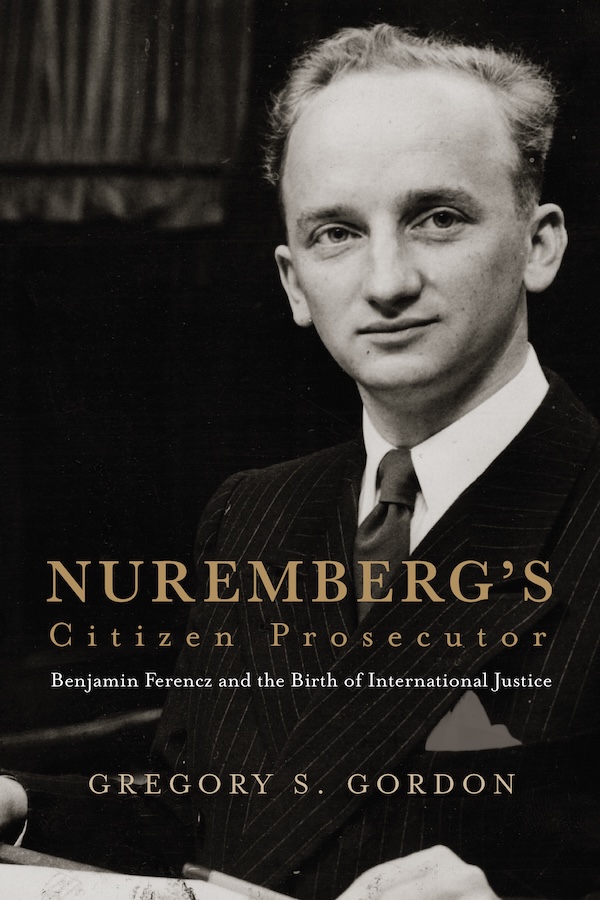
Nuremberg's Citizen Prosecutor
Benjamin Ferencz and the Birth of International Justice
Gregory S. Gordon
The remarkable life of one of the twentieth century’s great warriors for justice, from Nuremberg to the first trial of the International Criminal Court
On September 29, 1947, in Courtroom 600, before the Nuremberg Military Tribunal, twenty-seven-year-old Benjamin Ferencz approached the lectern to deliver the prosecution’s opening statement against Hitler’s brutal henchmen of the Einsatzgruppen—the SS killing units responsible for more than 1.5 million deaths during the Holocaust—in what the Associated Press dubbed “the biggest murder trial in history.” As the field of international criminal justice was being born in the aftermath of World War II, only Ferencz led in all its phases: investigation, prosecution, and restitution—an extraordinary feat given his humble origins as an impoverished immigrant escaping antisemitic persecution in Eastern Europe and growing up in New York’s Hell’s Kitchen. A Harvard Law scholarship student, Ferencz had been General Patton’s lead war crimes field investigator before becoming a chief prosecutor at Nuremberg. Horrified by what he encountered, he dedicated his career to Holocaust survivors, pioneering key restitution efforts and helping negotiate the landmark reparations treaty between West Germany, Israel, and Jewish civil society. Later, he became a peace advocate and driving force behind the creation of the International Criminal Court, remarkably joining the prosecution for the Court’s first trial as the last living Nuremberg prosecutor.
Gregory Gordon, a former war crimes prosecutor himself and the first scholar with full access to Ferencz’s personal papers, has produced an expansive, page-turning biography that uncovers incredible, and previously unknown, details about Ferencz’s remarkable life. In this first major biography of the Nuremberg prosecutor in English, Gordon reveals fascinating missing links running through Ferencz’s career which throw into a whole new light his landmark achievements.
- Human Rights QuarterlyGregory Gordon has produced a blockbuster . . . [This] is destined to be a definitive work on the life of an intriguing public figure who adorned the world stage. The amazing depth of the information in the book reminds me of the detail amassed by Ron Chernow in his biographies of Hamilton and other United States worthies. The prose is very lively.
- The European Review of BooksGordon has written a gripping history of international justice and the story of an extraordinary man whose path would cross with people like the philosopher Hannah Arendt, the German chancellor Konrad Adenauer and the movie star Angelina Jolie.
Part novel, part psychological study, and part handbook on effective lawyering, Gregory Gordon’s Nuremberg’s Citizen Prosecutor is a thoroughly researched and riveting book, worthy of its one-of-a kind human being, Benjamin Ferencz.- Martha Minow, former dean of Harvard Law School, author of Between Vengeance and Forgiveness: Facing History After Genocide and Mass Violence
A definitive biography. Gordon has brought his very formidable research, narrative, and legal skills to the task, and the result is an exceptionally important and highly readable contribution not only to the history of international criminal law and justice but also to the history of the twentieth and twenty-first centuries.- Eli M. Rosenbaum, former director, Office of Special Investigations and Counselor to the Attorney General on War Crimes Accountability, United States Department of Justice
Gordon beautifully, and honestly, chronicles the remarkable career of this hero of international justice. A remarkable book about a remarkable person.- Beth Van Schaack, Stanford University, former United States Ambassador-at-Large for Global Criminal Justice, Beth Van Schaack, Stanford University former United States Ambassador-at-Large for Global Criminal Justice
Gordon’s deeply researched biography gives us Ben Ferencz in full, human, and powerful detail. In dark times, this book will inspire everyone who cares—and all should—to carry forward Ben Ferencz’s vital work: for law to stop war.- John Q. Barrett, St. John's University, biographer of US Supreme Court Justice and Nuremberg chief prosecutor Robert H. Jackson
Ferencz's life, scrupulously researched and beautifully rendered by Gregory Gordon, is an utterly riveting story, packed with significance for the history of the laws of war, the Holocaust, and the twentieth century.- William I. Hitchcock, University of Virginia, author of The Bitter Road to Freedom: A New History of the Liberation of Europe
This admiring book shimmers with the author’s enthusiasm and will be invaluable for students of international criminal law.- Jonathan Bush, Columbia Law School
- Moment MagazineAlthough his admiration for Ferencz’s achievements and his affection for his subject are apparent, Gordon is also a clear-eyed writer who interrogates him with rigor . . . An essential read . . . [A] beautifully written book.
Gregory S. Gordon is Professor of Law at Peking University School of Transnational Law and the author of Atrocity Speech Law: Foundation, Fragmentation, Fruition.

