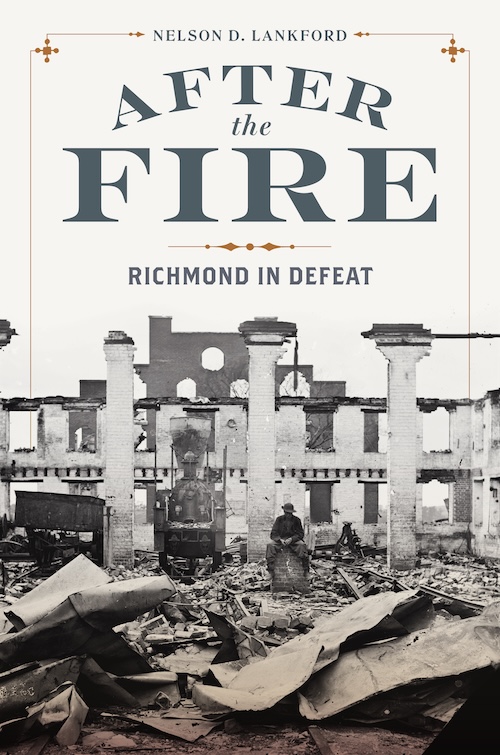
After the Fire
Richmond in Defeat
Nelson D. Lankford
How the Confederate capital’s citizens, white and Black, faced their future in the wake of Union victory
In April 1865, the Civil War, which had consumed the lives of the residents of Richmond, Virginia, for four years, ended in a vast conflagration that nearly destroyed their city. As Confederate troops fled and Union forces streamed in, the world they had known literally went up in flames. None could predict what would replace it when the smoke cleared.
After the Fire tells what happened next, offering a kaleidoscope of perspectives to evoke a vanished world of privation, defeat, jubilation, false starts, engrained antagonism, and the lost causes of Confederate nostalgia and of racial reconciliation. Nelson Lankford deftly narrates the desperate struggle of Confederates and Unionists, men and women, and white and Black Americans to shape the postwar landscape. Unsettling any sense of inevitability about this pivotal moment in history, Lankford puts the reader in the shoes of those who lived through it.
- Virginia Magazine of History and BiographyLankford has bestowed on his home city a monument to its history. After the Fire: Richmond in Defeat is an excellent book, erudite in its analysis and enjoyable in its storytelling. It completes the narrative of the social chaos wrought by the destructive fire in the city's commercial district during the final days of the Civil War detailed in his book, Richmond Burning (2002). But After the Fire offers readers considerably more than a mere sequel; it stands on its own as a serious scrutiny of the urgent social and economic issues defining the early months of Reconstruction. The challenging, sporadic, and gradual rebuilding of Richmond's 'Burnt District' thus serves as both testimonial and metaphor for the triumphs and tragedies of the reconstruction process.
I was pulled through this powerful story. Richmond, and this singular historical moment, emerge in wonderful detail and clarity.- Edward L. Ayers, former president of the University of Richmond and Bancroft Prize-winning author of American Visions: The United States, 1800-1860
A triumph. Lankford introduces an almost Shakespearian cast of characters and vividly depicts the worlds made and unmade in the Confederate capital. He has a painter’s touch in presenting places, a photographer’s eye for the image that reveals all, a journalist’s sense for the story that counts, and a historian’s smarts and skills. After the Fire has a rare 'you are there' quality and credibility that takes the reader back to Richmond like no other.- Randall M. Miller, Saint Joseph's University, co-author of The Northern Home Front during the Civil War
To live through the aftermath of the Civil War was to withstand the great drama of war, cessation, and the remaking of the nation and to experience the smaller, quotidian facets of life at the same time. So often, books convey one side of that equation or the other – the high level change or the granular texture of daily life, but this book does both. Its great strength is to restore the contingency that Richmonders who lived through the transition actually experienced.- Chandra Manning, Georgetown University, author of Troubled Refuge: Struggling for Freedom in the Civil War
Nelson D. Lankford is the former editor of the Virginia Magazine of History and Biography and the author of Richmond Burning: The Last Days of the Confederate Capital.

