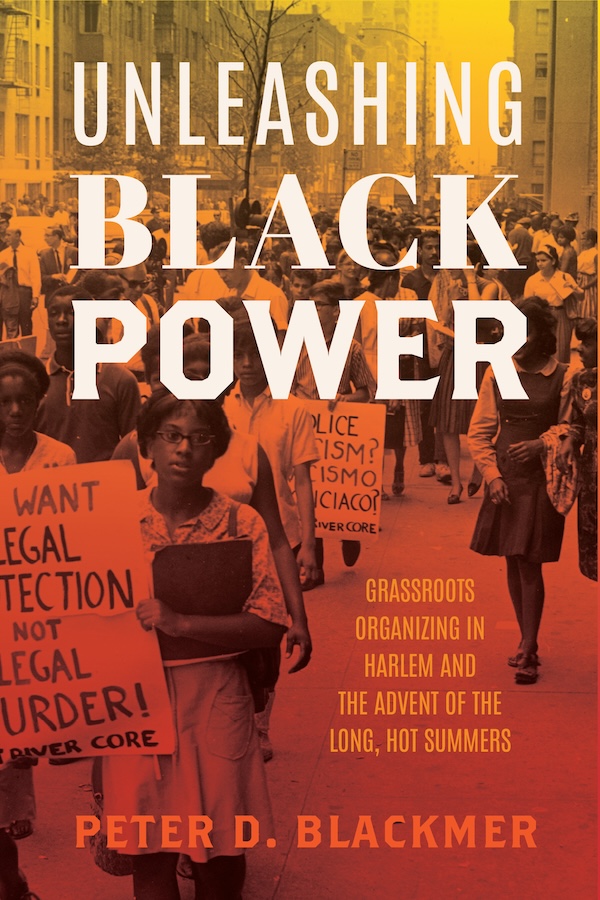
Unleashing Black Power
Grassroots Organizing in Harlem and the Advent of the Long, Hot Summers
Peter D. Blackmer
Reappraising the rise of the civil rights movement in the iconic center of Northern Black life
Unleashing Black Power explores the local dynamics, national connections, and global context of the Black freedom movement in Harlem from 1954 to 1964, illuminating how activists, organizers, and ordinary people mounted their resistance to systemic racism in the Jim Crow North. The richness of Black radical thought and action in this period made Harlem a key battleground in the national civil rights movement, transformed local Black grassroots politics, and facilitated the rise of Black Power in New York City. At the same time, the city’s attempts to clamp down on activists revealed the repressive nature of Northern liberalism and heralded the expansion of the carceral state. Peter Blackmer argues that this decade of confrontations between Black communities and white state power caused Harlem residents and activists to seek “new means” for achieving freedom within a city, state, and nation determined to deny it. Tracing the dual evolution of Black radicalism and white resistance, Unleashing Black Power offers a new framework for analyzing the epochal urban uprisings in the 1960s.
No one has ever taken this kind of deep dive into Harlem Radicalism in the late 1950s and early 1960s, exploring the complex political environment Black radicals in NYC were forced to navigate at a moment when the attention of the nation was focused on the Southern civil rights movement. Blackmer shows that the Black Radical Tradition in the US was vibrant even in years when many scholars thought it had declined. His book brings many grassroots leaders to life who deserve the attention. It should be read widely.- Mark D. Naison, Fordham University, author of Communists in Harlem During the Depression
A needed book. Its focus on Black radicalism in New York in the decade before the Harlem uprising and the assassination of Malcolm X, and its centering of Black women organizers, is particularly valuable.- Jeanne Theoharis, Brooklyn College, author of King of the North: Martin Luther King Jr.'s Life of Struggle Outside the South
- History: The Journal of the Historical AssociationBlackmer’s deeply researched study furnishes something substantially and valuably new: a panoramic exploration of ten years of Harlem activism that exerted a powerful influence on the transformation of the wider African American freedom struggle over the course of the 1960s.
- Mariame Kaba · Prisons, Prose & Protest: A Monthly Newsletter[The Civil Rights Movement] benefited from Harlem’s leadership. The long, hot summers of Black uprising grew out of ideas, tactics, and resistance that developed in parallel and in dialogue with the Southern civil rights fight. To recapture Harlem’s radical history from 1954 to 1964 is to recapture the national, and indeed global, continuity of the Black freedom struggle.
Peter D. Blackmer is Assistant Professor of Africology and African American Studies at Eastern Michigan University.

