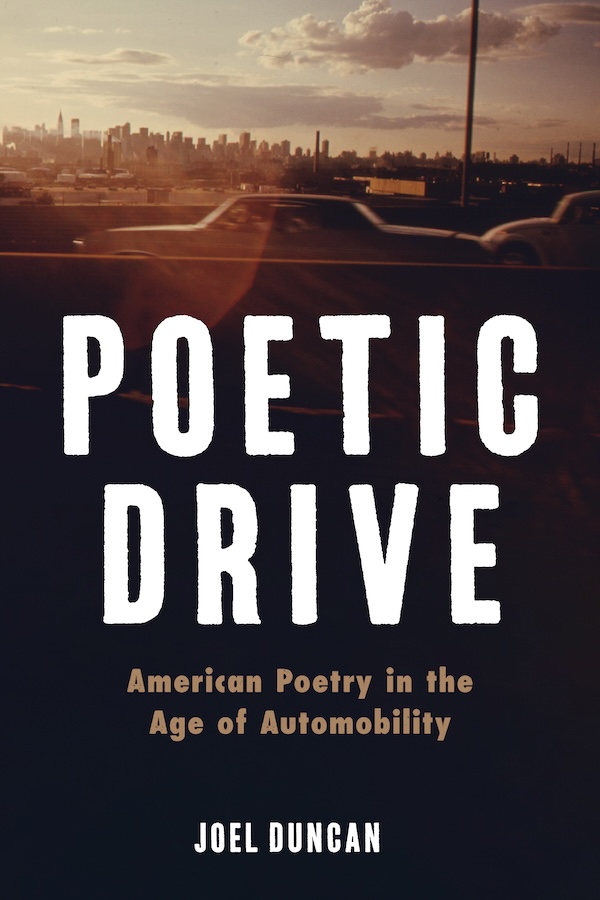
Poetic Drive
American Poetry in the Age of Automobility
Joel Duncan
How American poets have explored driving, in all its facets
“Whither goest thou, America,” asked Jack Kerouac in On the Road, “in thy shiny car in the night?” For American poets, the act of driving has always harbored a critical dichotomy. It can express the thrill and the freedom of the open road, but it can also foster fears of ecological catastrophe, crashes, and police violence. In Poetic Drive, Joel Duncan examines the writings and experimental film collaborations of William Carlos Williams, Charles Olson, Frank O’Hara, Eileen Myles, and Claudia Rankine to show that while poets have consistently inhabited the driver’s seat as a vehicle for self-possession, they have also reckoned with the social exclusions and environmental destruction central to American automobility. These poets have at times left their cars behind as stalled junk, or simply stopped driving them, mourning the forms of violence they encountered behind the wheel.
While previous studies have considered road novels and films, Poetic Drive is the first book to explore how American poets have harnessed the contradictory nature of automobility in crafting new work. By tracking poets’ vexed engagements with automobility over more than a century, Duncan offers a unique contribution to ecopoetics and petrocultures scholarship that expands our understanding of the place of driving in American literature and culture.
An admirable and illuminating work of scholarship and a fascinating contribution to the various critical and theoretical discourses currently underway around automobility and petroculture. Duncan explores a dynamic tension between a vision of freedom afforded by driving, which manifests in a kind of reckless experimentalism, and an awareness of the wreckage in its wake: the violence, danger, and damage (personal, social, and ecological) that serve as the underside of that freedom.- Brian Glavey, University of South Carolina, author of The Wallflower Avant-Garde: Modernism, Sexuality, and Queer Ekphrasis
Poetic Drive charts a compelling course through the history of American automobile culture as narrated by key figures in American poetry from William Carlos Williams to Claudia Rankine. Joel Duncan combines nuanced attention to the particular poetic forms of car production and culture with astute analysis of the automobile’s shaping force in American racial and economic life. Across its wide-ranging readings, Poetic Drive develops a convincing case for poetry as a key creative mode for reflecting on the social contradictions and ecological consequences of automobility.- Margaret Ronda, University of California, Davis, author of Remainders: American Poetry at Nature's End
- Modern PhilologyThe first monograph to attend specifically to driving and car culture in modern American poetry. This book is therefore original; it insists on an engagement of machine and poem that has hitherto mostly been taken for granted. With a sheaf of illuminating close readings and discoveries, it offers a history of the modulations of that engagement. Its great strength, moreover, is that it goes even further: it makes clear that in modern American poetry driving and car trips become a locale and topic that allows the poet to hold a mirror up to the totality of American culture.
- The Journal of Transport HistoryBy delving into the nuts and bolts of meter, prosody, and lineation, Duncan establishes poetry’s unique capacity to represent automobility, his term for the world that motor travel built.
Joel Duncan is a writer and educator living in Gothenburg, Sweden. He holds a PhD in English from the University of Notre Dame.

