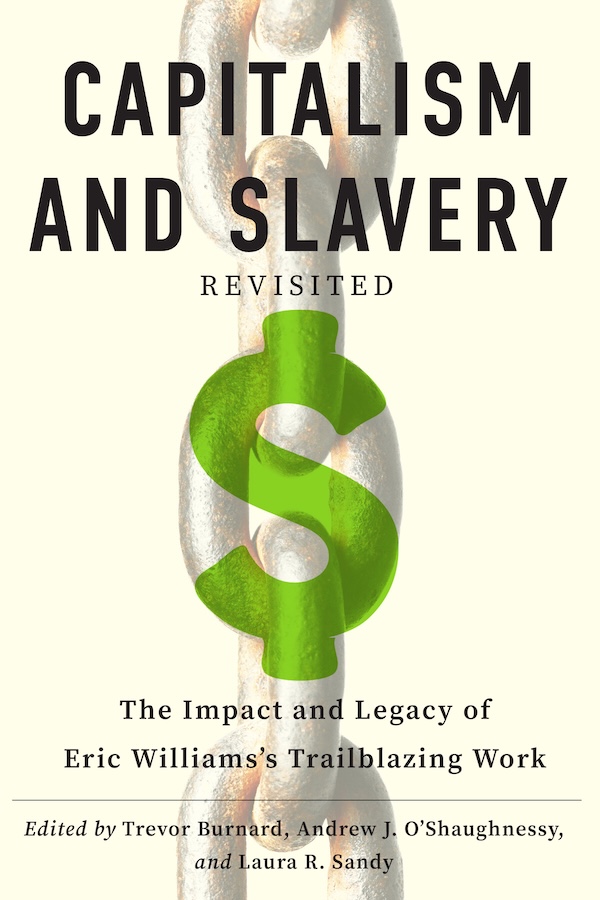
"Capitalism and Slavery" Revisited
Reexamining a seminal work on British capitalism and Caribbean slavery and its continuing reverberations in the twenty-first century
Eric Williams’s Capitalism and Slavery (1944), with its insightful and provocative theses about the relationship between Caribbean slavery and the growth of the British economy and the Industrial Revolution, has proved an enduring and controversial book. Never out of print since its publication, it is constantly being reevaluated and reassessed in the light of changing scholarship and new understandings of race, slavery, and capitalism. Recent years have seen considerable interest in the topics that first motivated Williams’s lively and polemical work. The essays in this collection dissect the links between the existence of racial slavery in the Americas, the concomitant rise of capitalism, and the vital role of both slavery and capitalism in the making of the modern world—essential topics not just in the reevaluation of Williams’s ideas for the twenty-first century but as areas of fierce interest and even fiercer debate in contemporary intellectual life.
- Walter Johnson, Harvard University, author of River of Dark Dreams: Slavery and Empire in the Cotton KingdomEric Williams' Capitalism and Slavery is one of those books — a book that continues to demand close attention and inspire serious engagement. These essays pull forward Williams' legacy even as they tug on forgotten threads and twist new meanings out of old questions. It is a delight to be again in the intellectual company of Williams, joined here by a new generation of interlocutors.
- Radica Mahase, College of Science, Technology and Applied Arts of Trinidad and Tobago, author of Why Should We Be Called 'Coolies'? The End of Indian Indentured LabourA timely and vital collection, given the amplified calls for reparations by Caribbean governments. The contributors honor Williams’ legacy, but more importantly, they also encourage readers to critically engage with his ideas, eighty years later. Without writings like these, the history of slavery and its relationship to Europe’s development, as well as the wider context of West Indian history, fade into oblivion. A valuable addition to the existing historiography.
Trevor Burnard was Professor of History at the University of Hull. Andrew J. O’Shaughnessy is Professor of History at the University of Virginia. Laura R. Sandy is Reader in History at the University of Liverpool.

