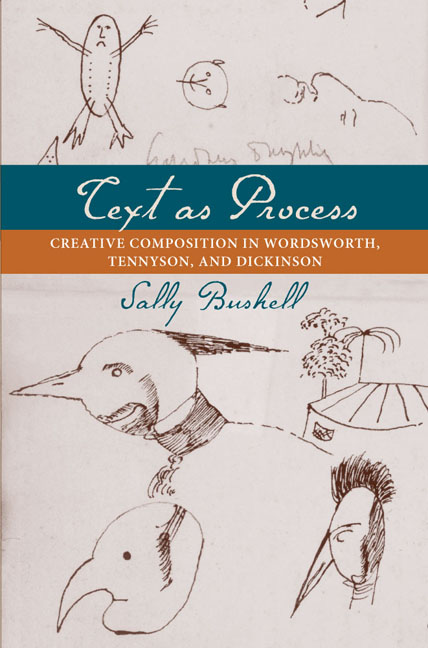
Text as Process
Text as Process is about the literary work before it becomes a completed work of art. It is concerned with draft materials, with the manuscripts that constitute text in a state of process. What is text as process? And what should we, as readers, try to do with it?
Bushell’s aim in Text as Process is to develop a research method for the study of compositional material. Although she draws on an international context—mainly French and German traditions—for current approaches to textual criticism, hers is the first book to apply a new form of critical analysis to authors in the Anglo-American tradition.
Bushell revisits issues of intention within process and makes this the center of her new approach, employing "case studies" of the work of three major nineteenth-century poets: Wordsworth, Tennyson, and Dickinson. She applies her methodology to each writer in different ways, allowing for cross-comparison as well as the recognition of individual distinctiveness in creativity. In doing so, Bushell demonstrates the need for a unique hermeneutics in relation to the making of the literary work of art. The author concludes with a philosophical account of the status and meaning of the literary work as it comes into being.
- Jack Stillinger, Center for Advanced Study Professor of English, Emeritus, University of Illinois, Urbana-ChampaignThis is a major practical and theoretical study of how poems are written. Its focus is the heart of the creative process, with detailed descriptions of real writers in real situations of writing with real pens, ink, and paper—and then real editors, printers, publishers, purchasers, readers, reviewers, and so on in the further processes of the production of literary works. In the general field of literary study, I cannot think of a more important topic than how writers create their works. Sally Bushell does an excellent job with this topic.
Sally Bushell is Senior Lecturer in the Department of English and Creative Writing at Lancaster University in England.
Acknowledgments
Introduction
1. Contextualizing Process: Three Perspectives on Genetic Criticism
2. Theorizing Process: Origins, Agency, Intention
3. Reclaiming Process: Toward a Compositional Method
4. Wordsworth's Process
5. Tennyson's Process
6. Dickinson's Process
7. A Philosophy of Composition: The Coming-into-Being of the Literary Work
Notes
Bibliography
Index

