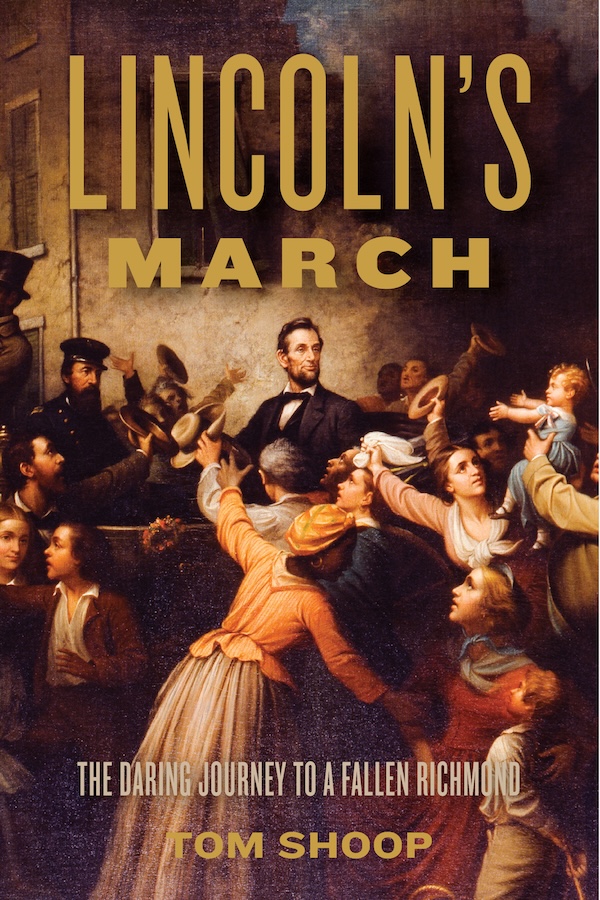
Lincoln’s March
Abraham Lincoln’s dramatic visit to the defeated Confederate capital in 1865, and how it has been remembered and reinterpreted since
“I want to see Richmond.” In April 1865, after four long years of civil war, the Confederate capital—less than one hundred miles from Washington, DC—finally fell to Union forces. Abraham Lincoln quickly declared his intention to go there, to stand in the epicenter of the rebellion, amid the still-smoldering ruins, and to greet its residents—white and Black—as the president of a soon-to-be reunited nation.
This book is the first dedicated to telling the story of his visit, but it goes well beyond narrating that remarkable day. Almost immediately, embellished accounts of Lincoln’s journey emerged, and the truth quickly fell victim to the needs of competing political agendas. Tom Shoop shows how ultimately Lincoln’s remarkable visit to a defeated Richmond would feed both the Lost Cause narrative and the mythology that Lincoln was uniquely capable of bringing North and South back together. Even as the story has faded from national memory, Lincoln’s March explains why it continues to resurface among those still arguing over the causes, consequences, and ongoing effects of the Civil War.
- Michael D. Gorman, historian, Civil War RichmondAbraham Lincoln’s 1865 visit to Richmond has long been shadowed in myth, story-telling, and outright lies. What happened in these crucial moments amongst the still-smoldering ruins of the Confederate capital is our only opportunity to glimpse Lincoln as himself, away from the political creatures of Washington (and deliberately off-the-grid), trying to direct the new America that he had worked to forge. Yet even participants in this event felt it necessary to embellish, place themselves at the center of the story, and put words in Lincoln’s mouth. Other important voices, like the sailors who rowed Lincoln to Richmond and the newly-emancipated enslaved people for whom Lincoln’s visit was the most singular event of their lives, are strangely silent. Tom Shoop wades into this historical morass to deliver a boldly written and well-researched work that addresses the myths as well as the realities of Lincoln’s visit to Richmond. For too long the mythology has held sway. No more.
- Sarah Purcell, Grinnell College, author of Spectacle of Grief: Public Funerals and Memory in the Civil War EraEven in a positive sea of books on Lincoln, this book is an original. Exceedingly well written and accessible, it also makes a substantial contribution to studies of Lincoln, the Civil War, and Civil War memory
- James J. Broomall, University of Richmond, author of Private Confederacies: The Emotional Worlds of Southern Men as Citizens and SoldiersA highly original and deeply interesting book about a pivotal moment in American history. Using this one remarkable episode, Shoop is able to explore the dual constructions of history and memory, the dramatic close of the American Civil War, and the contestation of monuments, public history, and historical interpretation.
Tom Shoop is an independent writer and historian. He is the author of A Place Called Ilda: Race and Resilience at a Northern Virginia Crossroads.

