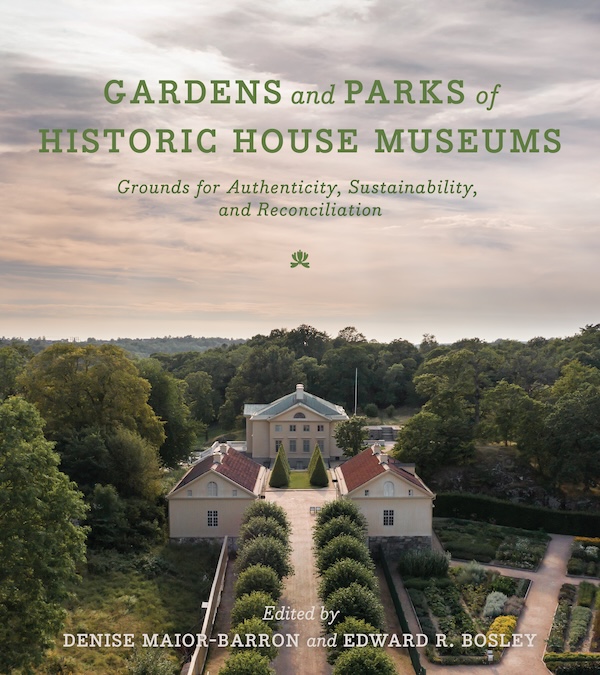
Gardens and Parks of Historic House Museums
On the importance, and economic survival, of historic houses and their gardens and parks
From royal estates to immigrant kitchen gardens, the case studies presented here speak to the importance of gardens and parks of historic house museums in illuminating the past, navigating the present, and preparing for the future. In this premier volume, site managers, owners, gardeners, scholars, and researchers explore landscape conservation and interpretation models that creatively address cultural, social, political, and climate change. Situated at the intersection of landscape, art, architecture, and heritage and cultural tourism, this book fills a scholarly gap in the critically important areas of authenticity, sustainability, and reconciliation. Whether focusing on the grounds of a whimsical Italian villa once home to a famous clown, those of a medieval-inspired castle in Cornwall, or the sculpture garden of an Outsider artist in South Africa, to note a few, the extensive international selections reveal how gardens and parks of house museums—increasingly relevant to diverse audiences with evolving expectations—have become crucial to the educational, cultural, and economic success of their sites.
- John Barnes, Chief Executive of Historic Royal Palaces, UK, and former Chair of ICOM DEMHISTHistoric house museums are about far more than the buildings at their centre. As this thoughtful and timely volume demonstrates, the gardens, parks and landscapes integral to the houses are often where people make their deepest connection with a place. Drawing on an impressive range of international case studies, Denise Maior-Barron, Edward Bosley and their contributors show how landscapes can enrich interpretation, confront difficult histories, respond to climate change and help institutions remain relevant to contemporary audiences.
- Max A. van Balgooy, George Washington University, coeditor of Reimagining Historic House Museums: New Approaches and Proven SolutionsThis volume will cause a rethinking of core assumptions in the world of house museums (by far the most common type of museum in the United States). It brings together gardens, landscapes, house museums, interpretation, authenticity, preservation, and sustainability — on a global scale — all in one book.
- Linda Young, author of Historic House Museums in the United States and the United Kingdom: A History (2017), Honorary Research Fellow at Deakin University and Museums Victoria.Few scholarly books address the museology of historic house museums, and even fewer consider their gardens, parks and landscapes – so this one is very welcome. Maior-Barron and Bosley bring deep knowledge and professional experience to the field, and the thirteen other contributors present a truly original cast of international case studies. Framed by its application to visitor interpretation, this book also advances the study of heritage management in historic house-and-garden sites from palaces to cottages.
- Prof. Robert Brown, contributing author to Encyclopedia of Vernacular Architecture of the World and co-author of 'Concepts of Vernacular Architecture' in The Sage Handbook of Architectural Theory.As any avid gardener or earnest amateur (my being the latter) can tell you, once you start digging into the soil you begin to uncover a stratum of intriguing and often surprising finds. Such discoveries range from fresh to forgotten roots, a thriving presence to past shells of life, and steadfast constructions to fragments of past interventions. Undoubtedly you will come across layer after layer of dirt, and even the very unexpected such as an unexploded bomb from past conflicts. Analogous to these acts and discoveries of gardening, the work of the editors and authors in this volume open up for us layer after layer of both persevering and shifting narratives, sensibilities, and social values that define the gardens and parks of historic house museums. Their inquiries into these at times robust and at times fragile gardens and parks reveal fertile ground for continuing exploration of questions on authenticity, and what this means for how we approach the interpretation and conservation of place.
- Gina Wouters, President and CEO of Planting Fields FoundationDenise Maior-Barron and Edward R. Bosley have contextualized historic house museums in a novel way by analyzing the stewardship of associated gardens and parks. Examining an integral yet often-overlooked feature of historic houses, the authors position landscapes not as ancillary, but features in need of holistic consideration and management. Historic landscapes are uniquely fragile to care for, especially in the face of complex environmental challenges and increased public use. Looking at eleven distinct case studies, the contributors address themes such as authenticity and preservation, which can be seen as paradoxical to natural spaces. Long overdue, this book will be a resource for theorists and practitioners alike that are seeking new ways of stewarding landscapes and engaging the public with places that have existed for a long time but need a fresh way of being seen, understood, and experienced.
- Gianluca Kannés, ICOM DEMHIST Board CouncilorThis work is an outstanding endeavor to link the literature on historic-gardens preservation with the most recent developments on house-museums debate. Part of its aim is to demonstrate how landscapes can contribute to the interpretation of a historical figure, or an era, sometimes even more than the related building when the latter has lost part of its original configuration. But above all, the book offers an original contribution to solve a well known impasse: a historic residence or garden is generally expected to witness the past, but the forces of evolution cannot be halted. Plants grow beyond established boundaries; certain species do not survive climate change; buildings must be brought up to safety standards, and frequently the original materials are no longer available. Thus, the essays collected in this volume serve as an extremely inspiring panel of alternative strategies for reinterpretation or restoration projects, and for reconciling often conflicting visions about heritage and authenticity.
Denise Maior-Barron is Adjunct Professor at Claremont Graduate University and a former Reader at the Huntington Library, Art Museum, and Botanical Gardens, San Marino, California. Edward R. Bosley is Emeritus Director of the Gamble House, Pasadena, California.

