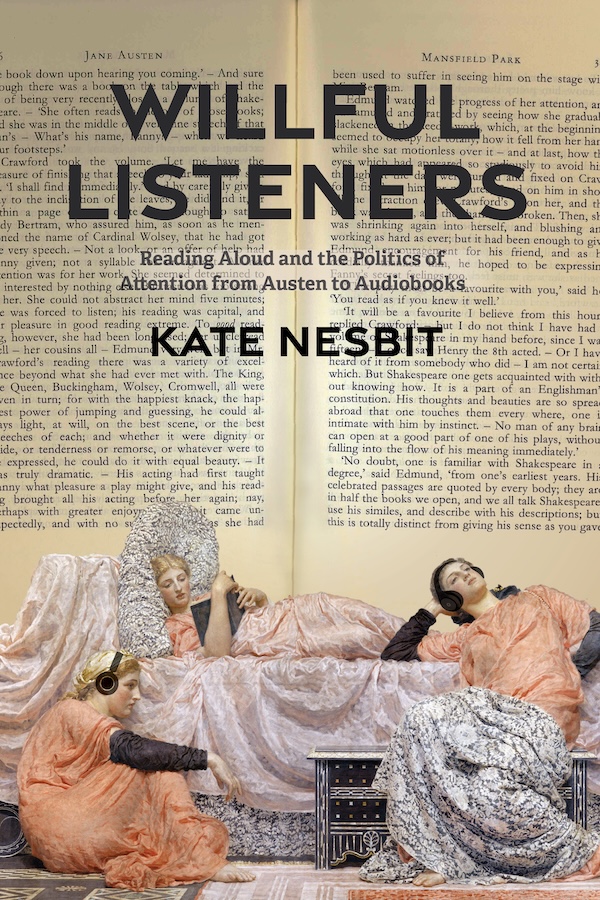
Willful Listeners
A cultural and literary history of domestic reading aloud
“Listening,” a recent Audible advertising campaign proclaimed, “is the new reading.” But this is no new phenomenon. In the nineteenth century, reading aloud was one of the most popular evening entertainments and one of the primary ways people consumed fiction. In Willful Listeners, Kate Nesbit considers the Victorian practice of reading aloud from the perspective of listeners—especially the rowdy and disobedient ones.
A counternarrative to more nostalgic portraits, this book spotlights fiction’s unruly audience: tired laborers who zone out while listening to the Bible, women who fall asleep to their husbands’ Shakespeare delivery, and children who eavesdrop on their parents reading the newspaper’s sex scandals. Nesbit analyzes the ritual of reading aloud not merely as an idealized form of domestic intimacy or a method of moral improvement but rather as a praxis enmeshed in the period’s contentious politics of attention. These scenes are about more than reading and reading aloud, Nesbit argues—they speak to attention’s ties to social hierarchy. These are moments that call into question assumptions about who needs to pay attention to whom, about whose voices were deemed worth a listen, and whose voices required amplification. This is a history of both the audiobook and its audience before sound recording.
- Matthew Rubery, Queen Mary University of London, author of Reader’s Block: A History of Reading DifferencesOne of the most engaging books I’ve read in years. I came away with a much richer sense of how complex scenes of reading aloud truly are and how much they reveal about the Victorian era and its values. This study exemplifies how the rise of new media in our own time, such as audiobooks, can spur us to look back on previous media from a different perspective.
Kate Nesbit is Associate Professor of English at Central College.

