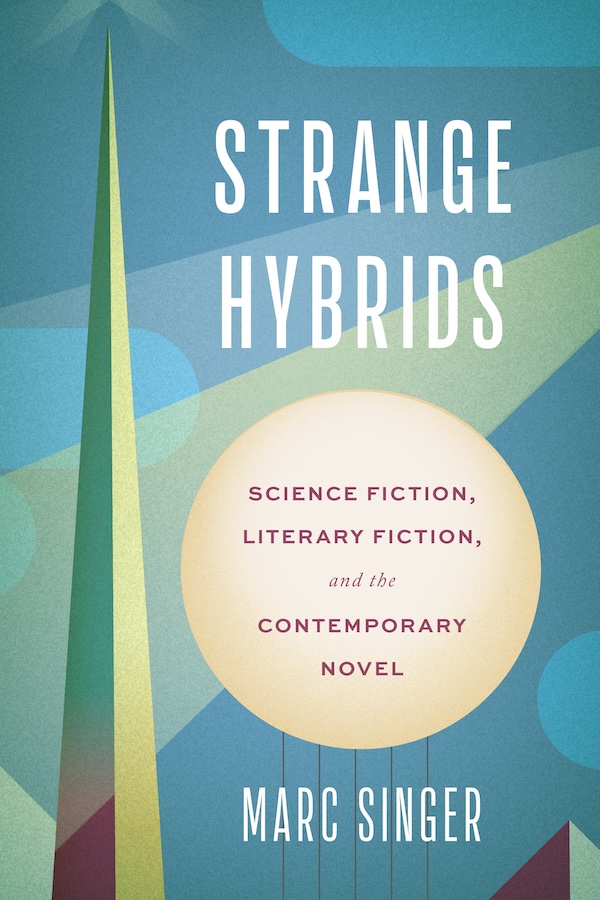
Strange Hybrids
How science fiction and literary fiction merge to represent today’s social, political, and environmental concerns
The future is now. Decades of accelerating technological, social, and environmental change have created a sense in the literary world that science fiction, rather than an augury of the future, may actually be the genre best equipped to describe the present.
Strange Hybrids examines the various ways contemporary novelists have adapted the structures and conventions of science fiction into literary depictions of our own world. Combining elements of both realism and speculative fiction, novelists such as Francis Spufford, Kim Stanley Robinson, Richard Powers, Jennifer Egan, and Colson Whitehead represent societies gripped by social, political, and ecological instability. Taking up questions of information science, climate change, medicine, economics, and more, their novels bridge the concerns of the sciences and the humanities to depict existing realities and imagine alternative ones. As descriptive as they are speculative, these novels demonstrate that science fiction offers an essential vocabulary for rethinking literature and its relationship to the contemporary world.
- Lee Konstantinou, University of Maryland, author of Cool Characters: Irony and American FictionAn original and well-argued book that adds much to the scholarly conversation about the genre turn. Singer shows how authors merge the toolkits of science fiction and realism to gain traction on various social problems. This is an invigorating and exciting work of criticism.
Marc Singer is Professor of English at Howard University and author of Breaking the Frames: Populism and Prestige in Comics Studies.
Acknowledgments
Introduction: Speculative Realism
1. The Future That Failed
2. The View From Mars
3. More than Human
4. Worlds Beyond Measure
5. Imagined Histories
Conclusion: Speculative Risks
Notes
Bibliography
Index

