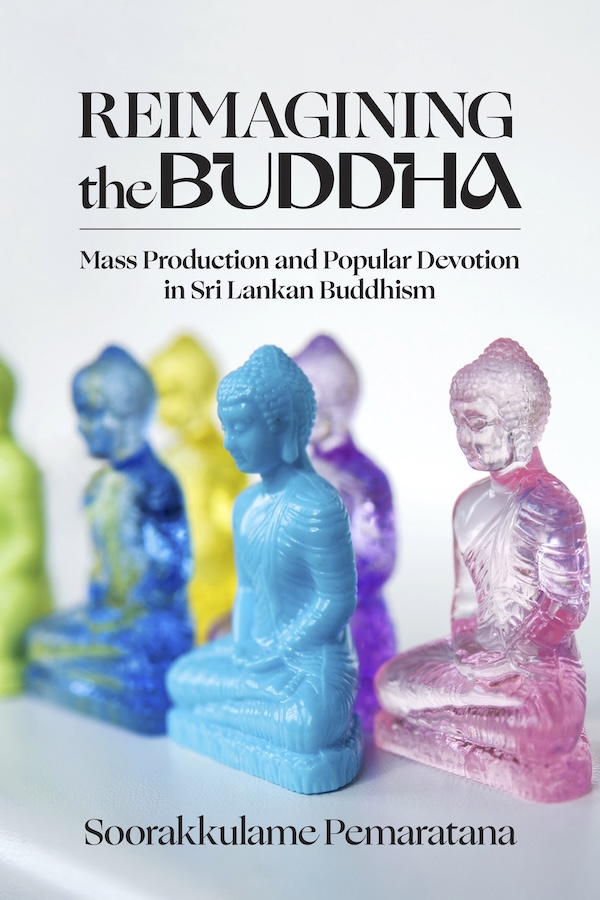
Reimagining the Buddha
How mass-produced religious imagery has impacted Buddhist life in Sri Lanka
Written by a practicing Buddhist monk, this religious ethnography of contemporary Sinhalese Buddhism examines how the recent proliferation of religious objects and images has evoked a new concept of the Buddha in contemporary Sri Lanka. Placed amid the mundane settings of homes, hospitals, prisons, offices, factories, shops, and roadsides, today’s more easily manufactured Buddha statues have elicited new forms of visual practice and bodily engagement. These representations of the Buddha play a new set of roles in healing and emotional support amid adversity, moral formation among children and adults, and the strengthening of family and social bonds. This Buddha is no longer merely a distant figure of the past who dispensed wisdom through the discourses preserved in the ancient Pali texts but a Buddha who cares, one who is both immanent and empathetic. Through personal interviews and groundbreaking archival research, Soorakkulame Pemaratana explores who the Buddha has become for Sinhalese Buddhists in the industrialized, postcolonial world they inhabit.
- John Clifford Holt, Bowdoin College, author of Theravada Traditions: Buddhist Ritual Cultures in Contemporary Southeast Asia and Sri LankaIn each of these carefully curated chapters, Pemaratana Soorakkulame’s interpretive foil is the so-called “scientific Buddha,” the ostensively Western intellectual construction of a rational, psychologically centered, anthropocentric spiritual virtuoso, the “Thus-Gone-One” with the wisdom of a Victorian-like gentleman! Against that foil, Pemaratana introduces a series of well-hewn cameos that empathetically portray how it is that the Buddha is respected, honored, venerated and understood in today’s Sri Lankan Sinhala Buddhist schools, in its hospitals, in neighborhood or village community initiatives, and in other explicitly public ritual times and spaces. Pemaratana is both an academic scholar and a senior Theravada Buddhist monk, both of which benefit this highly successful portrayal of the contemporary Buddha as an agentive, compassionate, ethical, and consummately caring power for the legions of his devout followers. This is a perfect book to introduce to undergraduate liberal arts students or those who have not lived in Sri Lanka or Southeast Asia after they have read centrally important Pali Buddhist suttas first, or vice versa.
Soorakkulame Pemaratana is Chief Abbot at the Pittsburgh Buddhist Center and Lecturer in History at Carnegie Mellon University. He is the author of Introduction to Buddhist Psychology.

