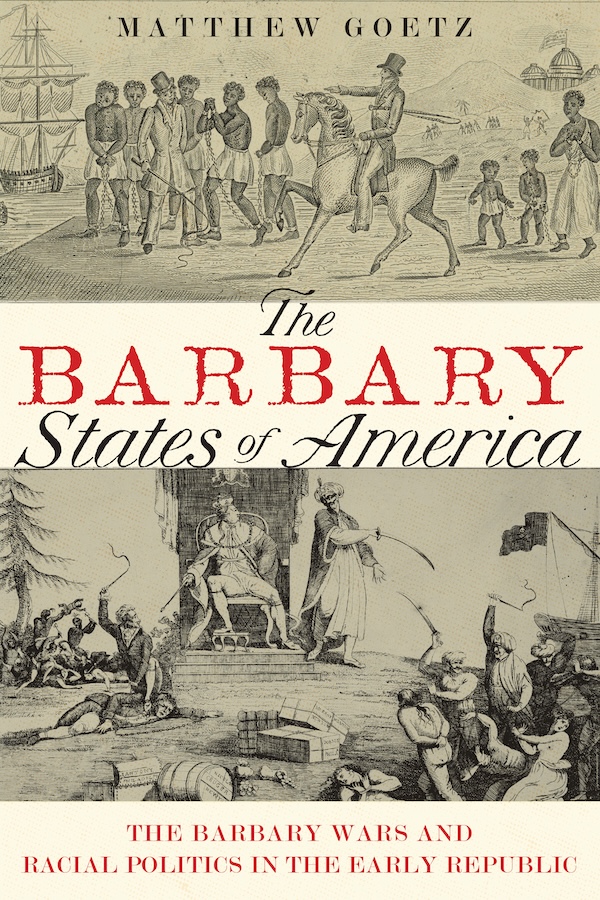
The Barbary States of America
How the Barbary Wars changed nineteenth-century American politics
Between 1785 and 1815, North African corsairs in the Mediterranean captured and enslaved around seven hundred American sailors and held them hostage. Forced to respond, the fledgling United States launched a series of naval campaigns to free them and prevent future attacks—known today as the Barbary Wars. In this groundbreaking study, Matthew Goetz examines the effects this signal conflict had on American racial politics back home, including the debate over slavery, the Atlantic slave trade, and Indian removal.
Goetz shows how, for many Americans, the Barbary Wars reinforced the racial prejudices that underpinned the white supremacist policies of the early republic. At the same time, antislavery activists seized on the hypocrisy of their fellow countrymen who decried the enslavement of white Americans by North Africans while simultaneously enslaving Black Americans. Political allies of Indigenous nations similarly pointed out that those who labeled the North Africans “barbarians” also advocated forcibly removing Native peoples from their lands. As Charles Sumner, the crusading senator from Massachusetts, contended, his slaveholding and ruthlessly expansionist country might be justly labeled “the Barbary States of America.”
- Abigail G. Mullen, United States Naval Academy, author of To Fix a National Character: The United States in the First Barbary War, 1800–1805In this critically important new work, Matthew Goetz provides a new and important answer to the question of why the Barbary Wars matter for American history. Many scholars have written about how the United States got to the Barbary Wars, but almost none have written about their aftermath. Goetz convincingly demonstrates that the Barbary conflict had echoes that redounded not only in its own time, but for decades afterwards. In so doing, he lays out the complicated relationship between Barbary captivity and American chattel slavery in the antebellum United States, an essential new interpretation that will change the way scholars talk about Barbary affairs.
Matthew Goetz is Senior Historian and Marlyne Sexton Chair in White House History at the White House Historical Association.

