Let Me Lie
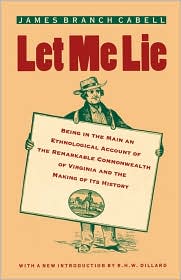
When Let Me Lie was first published in 1947, most reviewers missed the double meaning of the book's title. Deaf to James Branch Cabell's many-layered ironic wit, they read the book as a paean to the old South.
Readers of this new paperback edition are unlikely to repeat the mistake. Let Me Lie is indeed a carefully researched and brilliantly written historical narrative of Virginia from 1559 to 1946—focusing on Tidewater, Richmond, and the Northern Neck—but as a fictional scholar remarks in the book, Cabell's history is "both accurate and injudicious." Virginia's story of itself, Cabell claims, depends on illusion and myth, and his skill as a satirist allows him to construct and deflate these myths simultaneously. Ranging from Don Luis de Velasco and Captain John Smith to Edgar Allan Poe and Ellen Glasgow, from Confederate heroes to the oddities of the post-Civil War Old Dominion, Let Me Lie remains compulsively readable, as history, entertainment, or both.
No review available
James Branch Cabell (1879–1958) was the author of numerous works of fiction, history, criticism, and genealogy.
R. H. W. Dillard, Director of the Creative Writing Program at Hollins University, is the author most recently of Just Here, Just Now: Poems and Omniphobia: Stories.
An Editorial Note: About Murder in Self-Defence
The Prologue: Quiet Along the Potomac
Part One: The First Virginian
Part Two: Myths of the Old Dominion
Part Three: Colonel Esmond of Virginia
Part Four: Concerns Heirs and Assigns
Part Five: Mr. Ritchie's Richmond
Part Six: Almost Touching the Confederacy
Part Seven: General Lee of Virginia
Part Eight: Is of Southern Ladies
Part Nine: "Published in Richmond, Virginia"
Part Ten: Miss Glasgow of Virginia
An Epilogue: As to Our Life and Letters

