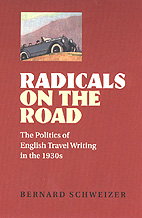
Radicals on the Road
In the 1930s, the discourse of travel furthered widely divergent and conflicting ideologies—socialist, conservative, male chauvinist, and feminist—and the major travel writers of the time revealed as much in their texts. Evelyn Waugh was a declared conservative and fascist sympathizer; George Orwell was a dedicated socialist; Graham Greene wavered between his bourgeois instincts and his liberal left-wing sympathies; and Rebecca West maintained strong feminist and liberationist convictions.
Bernard Schweizer explores both the intentional political rhetoric and the more oblique, almost unconscious subtexts of Waugh, Orwell, Greene, and West in his groundbreaking study of travel writing's political dimension. Radicals on the Road demonstrates how historically and culturally conditioned forms of anxiety were compounded by the psychological dynamics of the uncanny, and how, in order to dispel such anxieties and to demarcate their ideological terrains, 1930s travelers resorted to dualistic discourses.
Yet any seemingly fixed dualism, particularly the opposition between the political left and the right, the dichotomy between home and abroad, or the rift between utopia and dystopia, was undermined by the rise of totalitarianism and by an increasing sense of global crisis—which was soon followed by political disillusionment. Therefore, argues Schweizer, traveling during the 1930s was more than just a means to engage the burning political questions of the day: traveling, and in turn travel writing, also registered the travelers' growing sense of futility and powerlessness in an especially turbulent world.
- Michael Kowalewski, Carleton College, editor of Temperamental Journeys: Essays on the Modern Literature of TravelBernard Schweizer is adept at teasing out the covert and contradictory political implications of individual works, whether pointing out Orwell's nervousness about his complicity with an imperial system he both despised and represented, or noting that Waugh could be both an entertaining satirist (with a devastating rhetorical 'sting') and an insensitive bigot who willfully diminished the worth of foreign countries. This is an incisive and fair-minded study of English travel writing of the thirties.
- Patrick Holland, University of Guelph, coauthor of Tourists with Typewriters: Critical Reflections on Contemporary Travel WritingRadicals on the Road covers a period and a body of production that has been ignored in most of the previous critiques of travel writing. Schweizer's study neither blindly endorses the postcolonial perspectives of predecessor critiques, nor is it inconsistent with them—enabling new possibilities by complicating a body of literary criticism that has largely divorced postcolonial perspectives from the muddled and ebbing imperialist ideology of the inter-war years.
Bernard Schweizer, who works as an independent scholar in New York, is currently completing a book-length study of Rebecca West.

