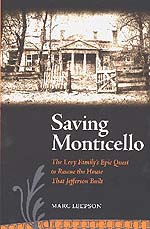
Saving Monticello
How a Jewish navy veteran and his descendants saved one of America's most recognizable architectural landmarks
When Thomas Jefferson died deeply in debt in 1826, his heirs were forced to sell thousands of acres of his land, his furniture and artwork, and eventually Monticello itself to make ends meet. In Saving Monticello Mark Leepson presents the absorbing history of Jefferson's famous home after his death, especially the little-known story of the Jewish family that saved it from falling into disrepair. Monticello twice came to the brink of ruin and was saved by two different generations of the Levy family, who cared for it as a national treasure for nearly a century. In 1833 Uriah Phillips Levy, a US Navy Commodore, purchased the house that the Marquis de Lafayette called "the most beautiful house in America" and committed considerable resources to restoring the mansion from its state of decay. After his death, Monticello again fell on hard times, with cattle housed on its first floor and grain in its upper rooms. Again a member of the Levy family stepped in: Uriah Levy's nephew, Jefferson Monroe Levy, a three-term New York congressman and wealthy real estate and stock speculator, who gained possession in 1879. Despite pouring hundreds of thousands of dollars into the upkeep of Monticello, Levy faced a vicious national campaign, with antisemitic overtones, to turn the building over to the government. The saga finally ended in 1923 with the purchase of Monticello by the Thomas Jefferson Memorial Foundation, and today half a million people make the pilgrimage to this fully restored national landmark every year.
- Norfolk Virginian-PilotHang on for a wild ride through history with colorful characters that even Jefferson’s imagination couldn’t have foreseen.
- Publishers WeeklyIn this excellent account of Monticello’s ownership after Thomas Jefferson’s death, Leepson... turns the spotlight on a family that contributed to the preservation of history.... With fascinating detail, Leepson uncovers the facts surrounding Monticello’s owners and preservation.
- Washington PostThis book provides useful and welcome evidence of the Levys’ role [in saving Monticello]. Leepson is a diligent, thorough researcher.... [A] good book.
- Chicago TribuneLeepson... has opened the curtain on a little-known portion of American history, and Saving Monticello is a welcome treat... a fascinating book.
- Richard Moe, President, National Trust for Historic Preservation (1993-2009)In its own way, the story of the Levys at Monticello is as compelling as the story of Jefferson at Monticello. It’s not simply a story of how a remarkable family saved a special place, it’s a very human story—indeed, a very American story—wonderfully told. I highly recommend it.
Marc Leepson is the author of nine books, including biographies of the Marquis de Lafayette and Francis Scott Key. His work has appeared in many newspapers and magazines, and he is a contributor to the Encyclopedia Britannica.

