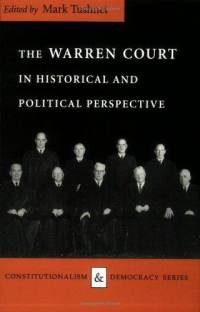
The Warren Court in Historical and Political Perspective
The tenure of Earl Warren as chief justice of the United States Supreme Court (1953-69) was marked by a series of decisions unique in the history of the Court for the progressive agenda they bespoke. What made the Warren Court special? How can students of history and political science understand the Warren Court as part of constitutional history and politics? To answer such questions, nine well-known legal scholars and historians explore how each justice contributed to the distinctiveness of the Warren Court in Supreme Court history.
No review available
Mark Tushnet is Associate Dean and Professor of Law at Georgetown University Law Center. He is the author of The NAACP's Legal Strategy against Segregated Education, 1925-1950; Red, White, and Blue: A Critical Analysis of Constitutional Law; and Making Civil Rights Law:Thurgood Marshall and the Supreme Court, 1936-1961.
1. The Warren Court as History: An Interpretation
I. The First Generation
2. Earl Warren's Influence on the Warren Court
3. Felix Frankfurter, the Progressive Tradition, and the Warren Court
4. William O. Douglas as Common Law Judge
5. Hugo L. Black and the Warren Court in Retrospect
II. The Central Figures of the Second Generation
6. John Marshall Harlan and the Warren Court
7. William J. Brennan and the Warren Court
III. The Second Generation
8. Byron White: A Liberal of 1960
9. Abe Fortas: Symbol of the Warren Court?
Notes
Bibliography
Contributors
Index

