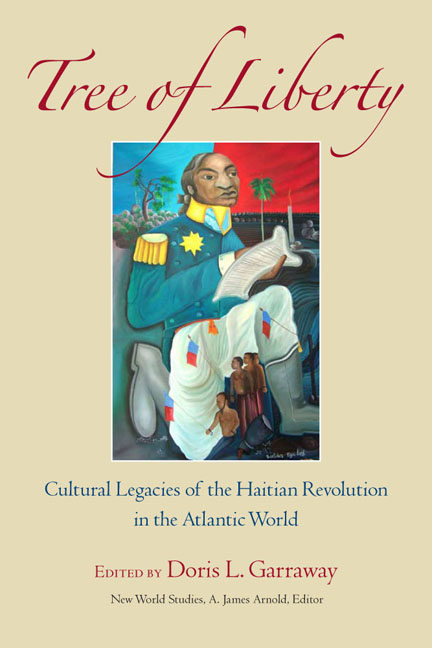
Tree of Liberty
On January 1, 1804, Jean-Jacques Dessalines declared the independence of Haiti, thus bringing to an end the only successful slave revolution in history and transforming the colony of Saint-Domingue into the second independent state in the Western Hemisphere. The historical significance of the Haitian Revolution has been addressed by numerous scholars, but the importance of the Revolution as a cultural and political phenomenon has only begun to be explored. Although the path-breaking work of Michel-Rolph Trouillot and Sibylle Fischer has illustrated the profound silences surrounding the Haitian Revolution in Western historiography and in Caribbean cultural production in the aftermath of the Revolution, contributors to this volume argue that, while suppressed and disavowed in some quarters, the Haitian Revolution nonetheless had an enduring cultural and political impact, particularly on peoples and communities that have been marginalized in the historical record and absent from the discourses of Western historiography.
Tree of Liberty interrogates the literary, historical, and political discourses that the Revolution produced and inspired across time and space and across national and linguistic boundaries. In so doing, it seeks to initiate a far-reaching discussion of the Revolution as a cultural and political phenomenon that shaped ideas about the Enlightenment, freedom, postcolonialism, and race in the modern Atlantic world.
Contributors:A. James Arnold, University of Virginia * Chris Bongie, Queen’s University * Paul Breslin, Northwestern University * Ada Ferrer, New York University * Doris L. Garraway, Northwestern University * E. Anthony Hurley, SUNY Stony Brook * Deborah Jenson, University of Wisconsin, Madison * Jean Jonassaint, Syracuse University * Valerie Kaussen, University of Missouri * Ifeoma C.K. Nwankwo, Vanderbilt University
- Sibylle Fischer, New York University, author of Modernity Disavowed: Haiti and the Cultures of Slavery in the Age of RevolutionAn interesting and engaging collection. Tree of Liberty unites in a single volume the most recent, cutting-edge scholarship.... The book will no doubt become an important resource for anybody who teaches and studies issues relating to the Haitian Revolution, anticolonial struggles and postcolonialism, racial politics in the Americas, and francophone literatures.
Doris L. Garraway is Associate Professor of French at Northwestern University and the author of The Libertine Colony: Creolization in the Early French Caribbean.
Introduction
I. Reading the Revolution: Contemporary Discourse and Ideology
Talk about Haiti: The Archive and the Atlantic's Haitian Revolution
Toussaint Louverture, Spin Doctor? Launching the Haitian Revolution in the French Media
"Legitime Defense": Universalism and Nationalism in the Discourse of the Haitian Revolution
Exploring Hymnody in Early American Needlework Samplers
II. After the Revolution: Rethinking Emancipation, Postcolonialism, and Transnationalism
"Charged with Sympathy for Haiti": Harnessing the Power of Blackness and Cosmopolitanism in the Wake of the Haitian Revolution
"Is He, Am I, a Hero?": Self-Referentiality and the Colonial Legacy in Aimé Césaire's Toussaint Louverture
Irrational Revolutions: Colonial Intersubjectivity and Dialectics in Marie Chauvet's "Amour"
Chroniques de la francohphonie triomphante: Haiti, France, and the Debray Report (2004)
III. Literary Representations of the Haitian Revolution
Recuperating the Haitian Revolution in Literature: From Victor Hugo to Derek Walcott
Toward New Paradigms in Caribbean Studies: The Impact of the Haitian Revolution on Our Literatures
"The First Epic of the New World": But How Shall It Be Written?
Bibliography
Notes on Contributors
Index

