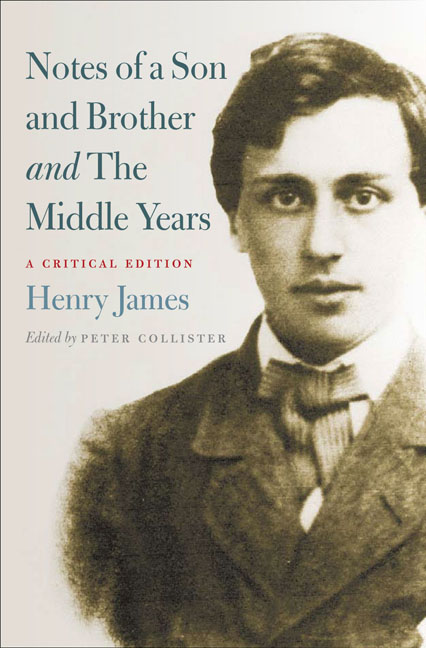
Notes of a Son and Brother and The Middle Years
After a childhood divided between America and Europe, Henry James settled with his family in New England, first in what he regarded as an outpost of Europe, Newport, and later in Cambridge. The family letters (the initial inspiration for this autobiographical enterprise), many of which recount the early career of William James at Harvard and in Germany, also reveal Henry James Sr.’s views on the intellectual, philosophical, and social issues of the time. Henry Jr., aspiring to be "just literary," acknowledges his indebtedness to the widely cultured artist John La Farge, whose friendship he enjoyed during adolescence. The Civil War is recorded through the letters of his younger brother, Wilky, while Henry recalls a Whitmanesque longing for the Union soldiers he met and talked to. The death of a beloved cousin, Mary Temple, who would become the inspiration for some of his greatest fictional heroines, is documented through the passionate, questioning letters she wrote in her final year of life. In The Middle Years James, newly resident in London, gives his impressions of some of the literary "lions" of the time, most notably George Eliot and Tennyson. This first fully annotated critical edition of Notes of a Son and Brother and The Middle Years both offers the reader extensive support in appreciating the demands of James’s late prose and illuminates the context in which one of literature’s most influential figures developed a characteristic voice.
- Colm Tóibín, author of The MasterThis new edition of Henry James's memoirs displays scholarship at its most painstaking and brilliant. The footnotes to the text actually represent an ingenious new biography of James and a marvelous and accurate portrait of his family and his circle. Peter Collister has done us all a great favor in the way he has approached James's efforts to re-create himself.
- Pierre A. Walker, co–general editor of The Complete Letters of Henry JamesIt is almost a century since Henry James's three autobiographical volumes first appeared. Only now, however, is a thoroughly researched and carefully edited critical edition becoming available. Students, scholars, and amateurs of James are greatly indebted to editor Peter Collister and to the University of Virginia Press for publishing this important new contribution to American literature.
- Choice[Reviewed in tandem with A Small Boy and Others, also edited by Peter Collister] The present two-volume critical edition of these memoirs makes a crucial contribution to James studies. Footnotes--so copious they often exceed James's text on the page--provide clarification, biographical and historical context, and relevant explanatory information. Drawn from archival sources and relevant James scholarship, the notes serve as a biographical companion, and often corrective, to James's version of his life. These volumes will prove indispensable for scholars and readers of James....Highly recommended.
- The Henry James ReviewCollister's editing sets a new standard for future editions of James's texts. We can now read both volumes of the autobiographies with a greatly enhanced understanding of the author's world.
- Nineteenth-Century ContextsCollister's historical contextualizing is impressive....[he] seems to have walked in [James's] footsteps and illuminates place and history....[This] edition likely to be unsurpassed as a scholarly resource....[whose] contribution is huge and, after nearly a century, deeply welcome.
- American Literary ScholarshipA valuable contribution to scholarship.
- Dan Mark Fogel, eminent Henry James scholar · Oxford Bibliographies OnlineThe first authoritative scholarly edition, this volume, in its extensive, discursive apparatus, counterpoints the texts of James's memoirs with what amounts to a virtual new biography of James running through Collister's invaluable and extensive annotations. First published 1914 (Notes of a Son and Brother) and 1917 (The Middle Years).
Peter Collister is the author of Writing the Self: Henry James and America

