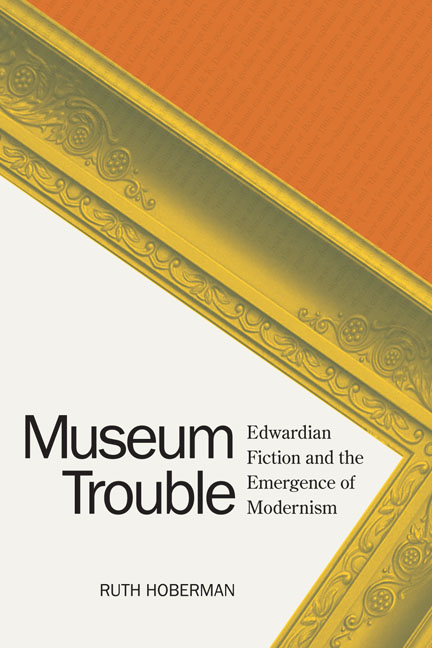
Museum Trouble
By 1901, the public museum was firmly established as an important national institution in British life. Its very centrality led to its involvement in a wide range of debates about art, knowledge, national identity, and individual agency. Ruth Hoberman argues that these debates concerned writers as well. Museum Trouble focuses on fiction written between 1890 and 1914 and the ways in which it engaged the issues dramatized by and within the museum.
Those issues were many. Art critics argued about what kind of art to buy on behalf of the nation, how to display it, and whether salaried professionals or aristocratic amateurs should be in charge. Museum administrators argued about the best way to exhibit scientific and cultural artifacts to educate the masses while serving the needs of researchers. And novelists had their own concerns about an increasingly commercialized literary marketplace, the nature of aesthetic response, the impact of evolution and scientific materialism, and the relation of the individual to Britain’s national and imperial identity.
In placing the many crucial museum scenes of Edwardian fiction in the context of late nineteenth-century and early twentieth-century cultural discourse, Museum Trouble shows how this turn-of-the-century literature anticipated many of the concerns of the modernist writers who followed.
- Ann Ardis, University of Delaware, author of Modernism and Cultural Conflict, 1880–1922Museum Trouble is a highly original and substantial contribution to scholarship on turn-of-the-twentieth-century British literature, visual art, and culture.
- Journal of British StudiesRuth Hoberman enlists an array of literary texts to illuminate her claim that modernism emerged not simply from the repudiated ruins of Victorian realism but instead from "the conflicts and ironies dramatized in late nineteenth- and early twentieth-century museum narratives" (166).... Museum Trouble makes a strong case for how modernists depended on such public institutions in order to dismantle them in form and thery.... There is a wealth of historical material in this book.... Organized and displayed well, Museum Trouble is its own verbal museum of Edwardian literary artifacts.
- Rupert Richard Arrowsmith, University College LondonThe Conjunction of literary history and museum studies explored in Museum Trouble represents an exciting new interdisciplnary field within the Humanities, and the book offers a timely and highly readable introduction to it.
- Marcia Farrell, Wilkes UniversityHoberman’s Museum Trouble is a readable and authoritative tract on Edwardian museum history, culture, and literature and would inform both the advanced student and the professional scholar.
- Nanette Norris, Royal Military College St. JeanIn her discussion of the development of museums at the turn of the twentieth century, Hoberman reveals an important portion of the impetus for the emergence of modernism at that time.
Ruth Hoberman is Professor of English at Eastern Illinois University and the author of Modernizing Lives: Experiments in English Biography, 1910–1939 and Gendering Classicism: The Ancient World in Twentieth-Century Women’s Historical Fiction.

