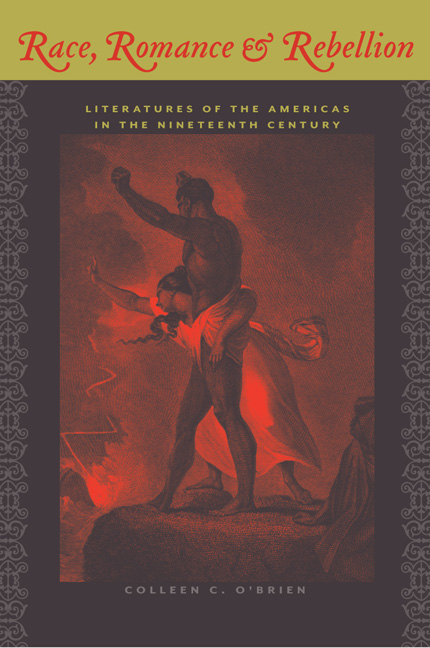
Race, Romance, and Rebellion
As in many literatures of the New World grappling with issues of slavery and freedom, stories of racial insurrection frequently coincided with stories of cross-racial romance in nineteenth-century U.S. print culture. Colleen O’Brien explores how authors such as Harriet Jacobs, Elizabeth Livermore, and Gertrudis Gómez de Avellaneda imagined the expansion of race and gender-based rights as a hemispheric affair, drawing together the United States with Africa, Cuba, and other parts of the Caribbean. Placing less familiar women writers in conversation with their more famous contemporaries—Ralph Waldo Emerson, Margaret Fuller, and Lydia Maria Child—O’Brien traces the transnational progress of freedom through the antebellum cultural fascination with cross-racial relationships and insurrections. Her book mines a variety of sources—fiction, political rhetoric, popular journalism, race science, and biblical treatises—to reveal a common concern: a future in which romance and rebellion engender radical social and political transformation.
- Debra Rosenthal, John Carroll University, author of Race Mixture in Nineteenth-Century U.S. and Spanish American Fictions: Gender, Culture, and Nation BuildingO’Brien’s astute reading of nineteenth-century novels, her smart choices of which texts to compare, and her evident engagement with the current literary conversation about race, gender, and nationalism make Race, Romance, and Rebellion a beautifully written and argued work.
- MELUSO’Brien’s greatest contribution is unmooring the reader’s understanding of the genres of romance and narratives of rebellion as gendered forms. O’Brien proposes that we examine the intersections of romance and rebellion in order to dimensionalize nineteenth-century female-authored texts. In so doing, O’Brien not only examines the dynamic relationship between the United States and the Americas as represented in these novels but also adds to the growing scholarship that reads women’s literature as integral in shaping the social and political world to which it also responds.
Colleen C. O’Brien is Associate Professor of English at the University of South Carolina, Upstate.
Acknowledgments
Preface
Introduction: To Foment Freedom
- “What Mischief Would Follow?”: Racial Boundaries, Antireformers, and White Space
- Colored Carpenters and White Gentlemen: Harriet Jacobs's Pedagogy of Citizenship
- Desire, Conquest, and Insurrection in Gertrudis Gómez de Avellaneda's Sab
- Republicanism and Soul Philosophy in Elizabeth Livermore's Zoë
- Reconstruction Optimism in Julia Collins's The Curse of Caste
- The End of Romance in Frances Watkins Harper's Minnie's Sacrifice
Conclusion
Notes
Bibliography
Index

