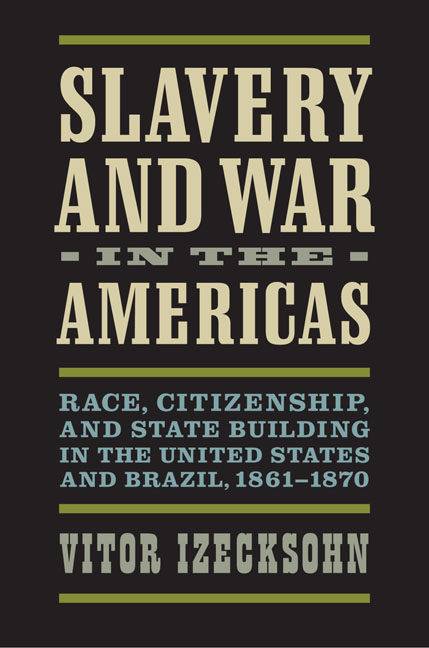
Slavery and War in the Americas
In this pathbreaking new work, Vitor Izecksohn attempts to shed new light on the American Civil War by comparing it to a strikingly similar campaign in South America--the War of the Triple Alliance of 1864–70, which galvanized four countries and became the longest large-scale international conflict in the history of the Americas. Like the Union in its conflict with the Confederacy, Brazil was faced with an enemy of inferior resources and manpower--in their case, Paraguay--that nonetheless proved extremely difficult to defeat. In both cases, the more powerful army had to create an elaborate war machine controlled by the central state to achieve victory.
While it was not the official cause of either conflict, slavery weighed heavily on both wars. When volunteers became scarce, both the Union and Brazilian armies resorted to conscription and, particularly in the case of the Union Army, the enlistment of freedmen of African descent. The consequences of the Union’s recruitment of African Americans would extend beyond the war years, contributing significantly to emancipation and reform in the defeated South.Taken together, these two major powers’ experiences reveal much about state building, army recruitment, and the military and social impact of slavery. The many parallels revealed by this book challenge the assumption that the American Civil War was an exceptional conflict.
A Nation Divided: Studies in the Civil War Era
- Don H. Doyle, University of South Carolina, author of The Cause of All Nations: An International History of America’s Civil WarVitor Izecksohn’s book is on the cutting edge of the current trend toward ‘internationalizing’ the study of the American Civil War. His comparisons to the horrific War of the Triple Alliance take us into far less familiar territory in South America than any other historian has ventured, and he guides us with skills and knowledge that few other scholars could claim.
- Peter Beattie, Michigan State University, author of The Tribute of Blood: Army, Honor, Race, and Nation in Brazil, 1864-1945Izecksohn presents an original and fruitful comparison of the recruitment difficulties confronted by the Union Army in the U.S. Civil War and the Brazilian imperial army for the War of the Triple Alliance. No other work has made such a sustained comparison of these two wars, and none has based this comparison on archival research on both sides of the equator.
- Journal of Southern History[ Slavery and War in the Americas] is a balanced and well-structured study that is sure to stimulate passionate debates in U.S. and Brazillian classrooms on the workings of race and citizenship in the two largest slave nations in the Americas.... It offers tantalizing insights into how the U.S. Civil War resonated in Brazilian public discourse, including among the enslaved
- Civil War Book ReviewIzecksohn's innovative comparative study... has broken new ground in more than one way, none the least also by utilizing several archival repositories, especially in Brazil, in order to engage fruitfully with this complex and worthwhile comparison.
- Hispanic American Historical ReviewPublished as part of a book series on the American Civil War (1861–1865), Vitor Izecksohn’s study is the result of his early concern with finding ways to contest the American exceptionalism interpretive model.... Izecksohn’s comparative approach show[s] that the American Civil War was no exceptional experience.
Vitor Izecksohn is Professor of History at the Universidade Federal do Rio de Janeiro, Brazil, and the coeditor of New Brazilian Military History.
Introduction
1. Military Traditions Confront Mass Mobilization in the United States and Brazil
2. The Crisis of the American Recruitment System: Union Army Recruitment, April 1861-July 1863
3. From Inertia to Insurgence: The Crisis in Brazilian Recruitment, 1865-1868
4. Forged in Inequality: The Recruitment of Black Soldiers in the United States, September 1862-April 1865
5. Manumitting and Enlisting the Slaves in Brazil, December 1866-August 1868
Conclusion: Processes, Effects, Distortions
Notes
Bibliography
Index

