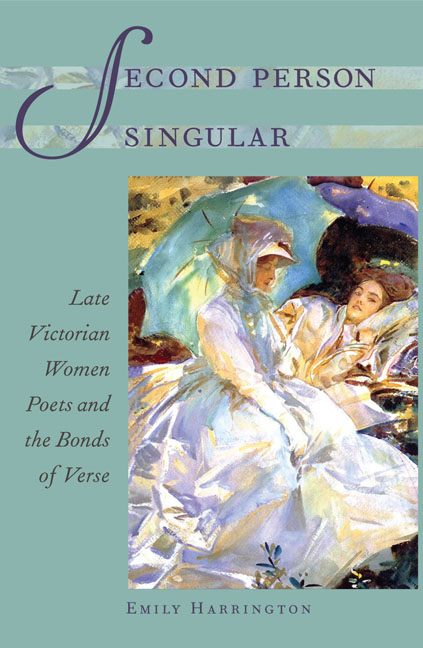
Second Person Singular
Emily Harrington offers a new history of women’s poetry at the turn of the century that breaks from conventional ideas of nineteenth-century lyric, which focus on individual subjectivity. She argues that women poets conceived of lyric as an intersubjective genre, one that seeks to establish relations between subjects rather than to constitute a subject in isolation.
Moving away from canonical texts that contribute to the commonly held notion that lyric poetry is an utterance made in solitude, Harrington explores the work of Christina Rossetti, Augusta Webster, A. Mary F. Robinson, Alice Meynell, and Dollie Radford to show how nineteenth-century poetic conventions shaped and were shaped by concepts of intimacy. Writing about relationships that are familial, divine, sexual, literary, and musical, these poets reconsidered the dynamics of absence and presence, and subject and object, that are at the heart of the lyric enterprise.
Harrington locates these poets' theories of intimacy not only in their formal poetic practice but also in diverse prose works such as prefaces, literary and devotional essays, and unpublished letters and diaries. By analyzing various patterns of versification and modes of address, she articulates new ways of thinking about the bonds of verse and enlarges our understanding of verse culture in the late nineteenth century.
- Alison Chapman, University of Victoria, coeditor of A Companion to Victorian PoetrySecond Person Singular is a powerful, bold, audacious study of women’s poetry at the end of the nineteenth century. This is a gem of a book, elegantly written and cogently argued, that tells the story of a missing piece of nineteenth-century literary history: the varying, complex, contradictory, and intertextual ways that fin de siècle women poets adopt forms of compression to articulate personal intimacy through a dynamic of proximity and distance.
- Joseph Bristow, UCLA, editor of Wilde Discoveries: Traditions, Histories, ArchivesWith exemplary clarity, Emily Harrington explores the ways in which gifted women poets of the late nineteenth century address intimate relations through lyrical forms. Yet, as Harrington shows, the songs and sonnets in which late Victorian women poets excelled are not usually expressions of undying love. Instead, through her attentive discussion of Christina Rossetti, Augusta Webster, A. Mary F. Robinson, Alice Meynell, Dollie Radford, and Mary E. Coleridge, Harrington reveals how these poets capture a central paradox of lyric: a genre that acknowledges the disconnections between the affectionate poetic voice and her objects of desire.
- Studies in English Lit....A refreshing discussion of the Victorian lyric as an intersubjective genre rather than one that immurs the self in isolation.
- Constance W. Hassett, Fordham University"Engaging analysis of the women poets’ historical and cultural context is Harrington’s strong point, providing what G.K. Chesterton might call ‘the rib of a strong intellectual structure’ to each of her chapters."
- Review 19In smart, lively, accessible prose, this book develops a series of original and insightful claims about a cluster of female poets who are steadily garnering increased and well-deserved critical attention.
Emily Harrington is Assistant Professor of English at the University of Colorado, Boulder.

