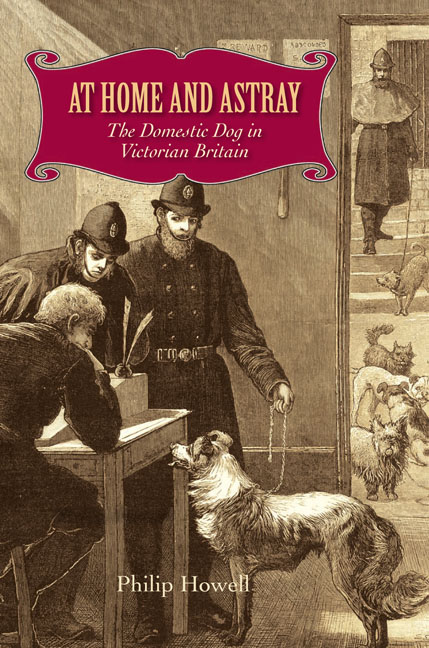
At Home and Astray
Although the British consider themselves a nation of dog lovers, what we have come to know as the modern dog came into existence only after a profound, and relatively recent, transformation in that country’s social attitudes and practices. In At Home and Astray, Philip Howell focuses on Victorian Britain, and especially London, to show how the dog’s changing place in society was the subject of intense debate and depended on a fascinating combination of forces even to come about.
Despite a relationship with humans going back thousands of years, the dog only became fully domesticated and installed at the heart of the middle-class home in the nineteenth century. Dog breeding and showing proliferated at that time, and dog ownership increased considerably. At the same time, the dog was increasingly policed out of public space, the "stray" becoming the unloved counterpart of the household "pet." Howell shows how this redefinition of the dog’s place illuminates our understanding of modernity and the city. He also explores the fascinating process whereby the dog’s changing role was proposed, challenged, and confronted—and in the end conditionally accepted. With a supporting cast that includes Charles Dickens, Elizabeth Barrett Browning, Thomas Carlyle, and Charles Darwin, and subjects of inquiry ranging from vivisection and the policing of rabies to pet cemeteries, dog shelters, and the practice of walking the dog, At Home and Astray is a contribution not only to the history of animals but also to our understanding of the Victorian era and its legacies.
- Garry Marvin, Roehampton University, coeditor of Routledge Handbook of Human-Animal StudiesIn the past few years nothing has given me greater pleasure to read than At Home and Astray. From the very beginning I was captivated by the issues it raised, the theoretical engagement demonstrated, and the beautifully clear, elegant, and wonderfully structured writing. There are other books on humans and dogs in the Victorian period, but none have the breadth or the nuanced intellectual sophistication of Howell’s book.
- Harriet Ritvo, MIT, author of Noble Cows and Hybrid Zebras: Essays on Animals and HistoryWith insight eclectically drawn from geography, cultural studies, and history, Philip Howell paints a compelling picture of the role of dogs in the bourgeois homes and mean streets of Victorian London
-Although the British have long considered themselves a nation of dog lovers, the dog as we know it came into existence only after a profound, and relatively recent, transformation in social attitudes and practices. In the Victorian age, the dog’s changing place in society was the subject of intense debate. It was accepted on the condition that it was recognized as owned property, a domesticated "pet." At the same time as it was taking up its privileges in the private sphere, however, the dog was increasingly policed out of public space, the "stray" becoming the unloved counterpart of the household "pet." With a supporting cast that includes Charles Dickens, Elizabeth Barrett Browning, Thomas Carlyle, and Charles Darwin, and subjects ranging from vivisection and the policing of rabies to pet cemeteries, dog shelters, and the practice of walking the dog, this book’s redefinition of the dog’s place illuminates our understanding of the modernity of the Victorian age, and of the Victorian city in particular.
- Studies in English Lit.A tremendously readable cultural history of the way that dogs...partake of our political relationships.
- Victorians Institute Journal... Howell takes an in-depth look at the ways in which the Victorians defined domesticity....[His] study is surprisingly moving, forcing readers to confront their own paradoxes. It is worthwhile for us, the dog lovers amongst us especially, to consider the ground zero at which the opinions about dogs and dog ownership began to form.
- Christy Lawrance · Journal of the Islington Archaeology & History SocietyHe revisits shared space when examining dog walking in the city, and how it became the unremarkable practice it is now. This book draws on a great deal of research and there is plenty to follow up.
- Journal of Social HIstoryThis study of the dog in Victorian Britain is a welcome academic contribution because it begins the academic work that allows us to see the dog in its own zoological space.
Philip Howell, Senior Lecturer in Geography at Cambridge University, is the author of Geographies of Regulation: Policing Prostitution in Nineteenth-Century Britain and the Empire.
Introduction
1. Dogs in Dickensland
2. Flush and the Banditti
3. Finding a Forever Home?
4. The Descent of the Dog
5. A Place for the Animal Dead
6. Assembling the Dog-Walking City
Conclusion

