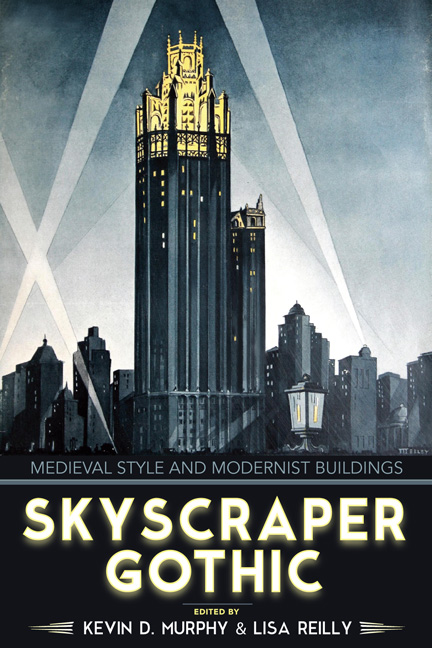
Skyscraper Gothic
Of all building types, the skyscraper strikes observers as the most modern, in terms not only of height but also of boldness, scale, ingenuity, and daring. As a phenomenon born in late nineteenth-century America, it quickly became emblematic of New York, Chicago, and other major cities. Previous studies of these structures have tended to foreground examples of more evincing modernist approaches, while those with styles reminiscent of the great Gothic cathedrals of Europe were initially disparaged as being antimodernist or were simply unacknowledged. Skyscraper Gothic brings together a group of renowned scholars to address the medievalist skyscraper—from flying buttresses to dizzying spires; from the Chicago Tribune Tower to the Woolworth Building in Manhattan.
Drawing on archival evidence and period texts to uncover the ways in which patrons and architects came to understand the Gothic as a historic style, the authors explore what the appearance of Gothic forms on radically new buildings meant urbanistically, architecturally, and socially, not only for those who were involved in the actual conceptualization and execution of the projects but also for the critics and the general public who saw the buildings take shape.
Contributors:
Lisa Reilly on the Gothic skyscraper ● Kevin Murphy on the Trinity and U.S. Realty Buildings ● Gail Fenske on the Woolworth Building ● Joanna Merwood-Salisbury on the Chicago School ● Katherine M. Solomonson on the Tribune Tower ● Carrie Albee on Atlanta City Hall ● Anke Koeth on the Cathedral of Learning ● Christine G. O'Malley on the American Radiator Building
- Michael J. Lewis, Williams College, author of American Art and ArchitectureSkyscraper Gothic presents its subject broadly and effectively. Essays deal incisively with the principal Gothic skyscrapers of the 1910s and 1920s—for example, the Chicago Tribune, the Radiator, and the Woolworth buildings—and in each case present previously unpublished material. This collection is well written, thoroughly researched, and accompanied by attractive and useful illustrations.
- Carol Willis, Founding Director, The Skyscraper MuseumThe skyscraper has proved to be America’s great, continuing contribution to the history of world architecture. But its early years presented a conundrum to its architects and client: how to dress the modernity of its steel frame in the mantle of artistic style and cultural meaning. For many reasons, as the eight contributors to this volume show, Gothic was a logical choice—vertical, skeletal, spiritual, aspiring. How extraordinary that this is the first book to address the manifold meanings of ‘skyscraper gothic.’
- SkyHighCityUp until Louis Sullivan famously suggested in 1896 that skyscrapers really ought to look like skyscrapers, architects would happily borrow from the vast pool of historic design elements. This defined the gilded age of skyscraper design, as documented in this book.... [It] bridges the gap between medieval and modernist buildings, and as such it sits perfectly in between topics which have already been extensively covered.... Skyscraper Gothic is a must-read.
- Journal of American HistorySkyscraper Gothic is a collection of excellent essays, each focused on a particular architect and one building. Its rich body of archival sources that derive from the architects and contemporary architectural critics allows for close analysis.... The scholarship of each of these chapters is impressive, based on a substantial documentary base, addressing key issues pertinent to the architect, client, structure, style—and to some extent public reaction.
- SkyHighCitySkyscraper Gothic bridges the gap between medieval and modernist buildings... a must-read. It’s very well written and edited, thoroughly researched and noted.
- CHOICEDespite the seeming antagonistic relationship between Gothic style and modern architectural developments, their integration served to express the functional and vertical quality of the skyscraper while also expressing its constructive logic. The book is generously illustrated and includes an invaluable bibliography. Summing Up: Essential.
Kevin D. Murphy, Andrew W. Mellon Chair in the Humanities and Professor and Chair of History of Art at Vanderbilt University, is the author of Memory and Modernity: Viollet-le-Duc at Vézelay. Lisa Reilly, Associate Professor and Chair of Architectural History at the University of Virginia, is the author of An Architectural History of Peterborough Cathedral.
Introduction: Skyscraper Gothic from Nineteenth-Century Origins to Postmodern Expressions
Design and Study of the Past: The Gothic Skyscraper
The Gothics of Francis Kimball: From Nineteenth-Century Revivals to the Early Skyscraper
Medievalism, Mysticism, and Modernity in Early Twentieth-Century New York: Cass Gilbert's "Skyscraper Gothic"
The Gothic Revival and the Chicago School: From Naturalistic Ornament to Constructive Expression
Tribune Tower: Medievalism and Memory in the Wake of the Great War
Forward Atlanta: G. Lloyd Preacher and the Atlanta City Hall
Gothic with an American Accent: The Cathedral of Learning
Radiant Heat and Glowing Lights: Raymond Hood's American Radiator Building
Selected Bibliography of Published Sources
Notes on Contributors
Index

