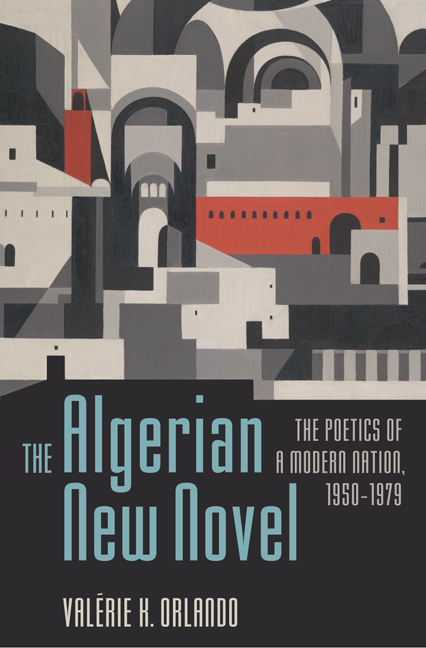
The Algerian New Novel
Disputing the claim that Algerian writing during the struggle against French colonial rule dealt almost exclusively with revolutionary themes, The Algerian New Novel shows how Algerian authors writing in French actively contributed to the experimental forms of the period, expressing a new age literarily as well as politically and culturally. Looking at canonical Algerian literature as part of the larger literary production in French during decolonization, Valérie K. Orlando considers how novels by Rachid Boudjedra, Mohammed Dib, Assia Djebar, Nabile Farès, Yamina Mechakra, and Kateb Yacine both influenced and were reflectors of the sociopolitical and cultural transformation that took place during this period in Algeria. Although their themes were rooted in Algeria, the avant-garde writing styles of these authors were influenced by early twentieth-century American modernists, the New Novelists of 1940s–50s France, and African American authors of the 1950s–60s. This complex mix of influences led Algerian writers to develop a unique modern literary aesthetic to express their world, a tradition of experimentation and fragmentation that still characterizes the work of contemporary Algerian francophone writers.
- Alison Rice, University of Notre Dame, author of Polygraphies: Francophone Women Writing AlgeriaThe Algerian New Novel contains unprecedented insights into the influence of texts often categorized as the French nouveau roman on Algerian literary works written in French from the 1950s until the end of the 1970s. By juxtaposing their work with the work of French authors, Valérie Orlando compels us to reconsider the status and composition of novels by Algerian writers during these pivotal thirty years. A compelling and solid study of a fascinating literary period with great significance for the present.
- Mildred Mortimer, University of Colorado, author of Women Fight, Women WriteIn a groundbreaking analysis of Algerian literature written in French from the 1950s through the end of the 1970s, Valérie Orlando explores the contradiction that Algerian authors of French expression defined their place in the literary world as contributors to a littérature de combat yet used experimental literary devices that reflected contemporary French narrative trends. The author argues convincingly that although the experimental narrative and forms of the French New Novel resonated with these writers, that source of inspiration never overshadowed their Algerian specificity. A must-read!
- The French Review[A] must-read book for any francophoniste,... Orlando convincingly shows how French nouveau roman authors impacted formand content of Algerian authors writing in French.Her rather broad approach—she does not privilege close readings but discusses political and cultural factors that influenced Algerian Francophone writing—might also interest non-specialist readers.
Valérie K. Orlando, Professor of French and Francophone Literatures and Cultures at the University of Maryland, College Park, is the author of Screening Morocco: Contemporary Film in a Changing Society, among other works.
Note on Translations
Introduction
1. Midnight Novelists
2. French Intellectuals, Violence, and the Algerian War
3. Assia Djebar's La Soif and Nathalie Sarraute's Portrait d'un inconnu: Defining the Authentic Self in the Exploration of a Possible World
4. Claude Ollier's Le Maintien de l'ordre and Kateb Yacine's Le Polygone étoilé: Writing the Modern Stories That Cannot Be Told on the Blank Pages of Algeria
5. Mohammed Dib's Habel and the Experimental Algerian Novel: Third World Movements and the Ideological and Literary "New Man"
6. Rachid Boudjedra's Topographie ideale pour une agression caractérisée: Labyrinths of Algerian Modernity
7. Nabile Farès's Yahia, Pas de chance, and Other Experimental Novels: Out of the Ruins Emerges a New Man and a New World
8. Yamina Mechakra's La Grotte éclatée: Reclaiming Algeria through the Poetics of Postcolonial Space
Afterword: Contemporary Modes of Being an Algerian Author
Notes
Bibliography
Index

