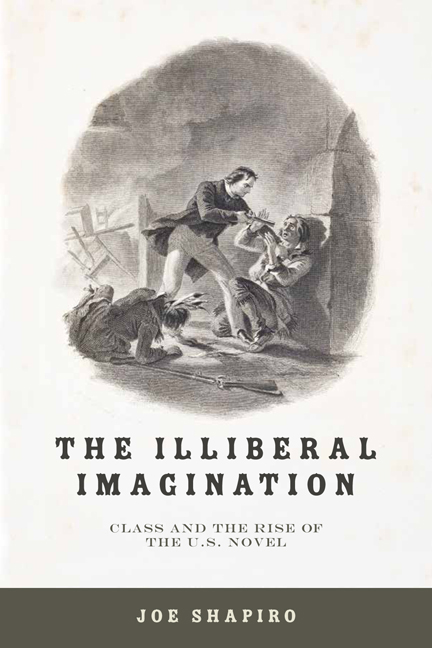
The Illiberal Imagination
The Illiberal Imagination offers a synthetic, historical formalist account of how—and to what end—U.S. novels from the late eighteenth century to the mid-1850s represented economic inequality and radical forms of economic egalitarianism in the new nation. In conversation with intellectual, social, and labor history, this study tracks the representation of class inequality and conflict across five subgenres of the early U.S. novel: the Bildungsroman, the episodic travel narrative, the sentimental novel, the frontier romance, and the anti-slavery novel.
Through close readings of the works of foundational U.S. novelists, including Charles Brockden Brown, Hugh Henry Brackenridge, Catharine Maria Sedgwick, James Fenimore Cooper, and Harriet Beecher Stowe, Joe Shapiro demonstrates that while voices of economic egalitarianism and working-class protest find their ways into a variety of early U.S. novels, these novels are anything but radically dialogic; instead, he argues, they push back against emergent forms of class consciousness by working to naturalize class inequality among whites. The Illiberal Imagination thus enhances our understanding of both the early U.S. novel and the history of the way that class has been imagined in the United States.
- Matthew Garrett, Wesleyan University"Admirably lucid and critically penetrating. Joe Shapiro’s book is a major contribution to U.S. literary studies that I believe will productively reframe the discussion of class and the novel."
- Philip Gura, UNC Chapel HillThrough astute readings of novelists from Charles Brockden Brown through Stowe, Shapiro clears a new path through the American literary landscape. The study of "class" in such fiction has needed an interpreter alert to the various ways writers acknowledged and tried to rationalize the growing inequalities in American life. Clearly and forcefully written, The Illiberal Imagination does this necessary work and is a model of patient, reasoned scholarship.
- CHOICEShapiro takes as his starting point the commonly held view that early American novels reflect foundational national myths about self-possessing individualism unhindered by ossified European class determinism.... Particularly interesting is Shapiro’s argument that the representational strategies of novelistic form facilitate class disparity.... Summing Up: Recommended. Upper-division undergraduates through faculty.
- American Literary History[E]xcellent, insightful, and incisive stud[y] that deserve[s] to be required reading within all of American studies as [it] seek[s] to address the larger question of liberalism, whether explicitly or structurally.... Shapiro’s study is adroitly argued and presents a refreshingly different cartography of US letters, as each chapter takes up lesserknown texts to unsettle the field’s assumptions that had been protected by selective reading lists.
Joe Shapiro is Associate Professor of English at Southern Illinois University Carbondale.

