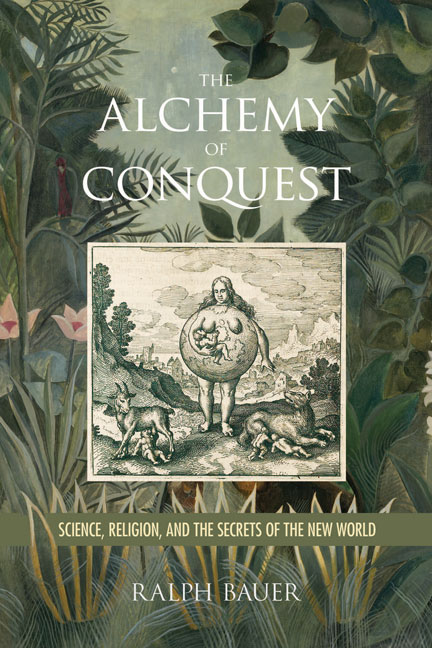
The Alchemy of Conquest
Aldo and Jeanne Scaglione Prize for Comparative Literary Studies, (2020); Aldo and Jeanne Scaglione Prize for Comparative Literary Studies, Modern Language Association (2020, Winner)
The Age of the Discovery of the Americas was concurrent with the Age of Discovery in science. In The Alchemy of Conquest, Ralph Bauer explores the historical relationship between the two, focusing on the connections between religion and science in the Spanish, English, and French literatures about the Americas during the early modern period.
As sailors, conquerors, travelers, and missionaries were exploring "new worlds," and claiming ownership of them, early modern men of science redefined what it means to "discover" something. Bauer explores the role that the verbal, conceptual, and visual language of alchemy played in the literature of the discovery of the Americas and in the rise of an early modern paradigm of discovery in both science and international law. The book traces the intellectual and spiritual legacies of late medieval alchemists such as Roger Bacon, Arnald of Villanova, and Ramon Llull in the early modern literature of the conquest of America in texts written by authors such as Christopher Columbus, Amerigo Vespucci, José de Acosta, Nicolás Monardes, Walter Raleigh, Thomas Harriot, Francis Bacon, and Alexander von Humboldt.
- Ruth Hill, Vanderbilt University, author of Hierarchy, Commerce, and Fraud in Bourbon Spanish America: A Postal Inspector’s ExposéThe Alchemy of Conquest is brilliant, as one would expect from Ralph Bauer. His book is strikingly original and elegantly conceived. One cannot overstate its importance to the histories of literature and science: it represents a paradigm shift.
- Sixteenth Century JournalWhat is clear throughout... this comprehensive account is that the pan-European literature on the Americas, scientific or other-wise, have a shared philosophical influence tying them all together. Bauer thus reinforces an important point: that the colonization of the Americas should be interrogated as a shared European experience and enterprise and that considering how the texts influence and borrow from one another deepens our understanding of a larger European colonial identity.
Ralph Bauer is Associate Professor of English and Comparative Literature at the University of Maryland and the author of The Cultural Geography of Colonial American Literatures: Empire, Travel, Modernity.
1. The Hermeneutics of Secrecy: Aristotle and Discovery
2. Egyptian Gold: Alchemy and Crusade in the Later Middle Ages
3. The Alchemy of Conversion: Ramon Llull's Chivalric Missionary Science
4. The Secrets of the World: Christopher Columbus's Ecstatic Materialism
5. The Llullian Renaissance and European Expansionism
6. Physicians of the Soul: The Alchemy of Reduction and Ethno-demonology in Early America
7. Cannibal Heterotopias in the Sixteenth Century
8. Homunculus americanus
9. The Blood of the Dragon: Alchemy and New World Materia Medica
10. Walter Raleigh's Legends: Black, Gold, and White
11. Things of Darkness

