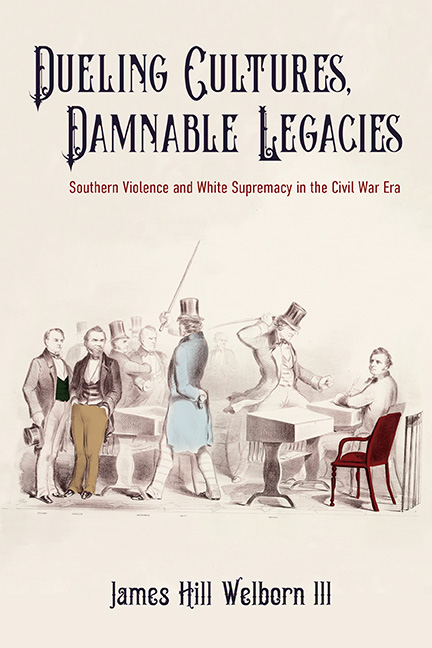
Dueling Cultures, Damnable Legacies
Southern Violence and White Supremacy in the Civil War Era
James Hill Welborn III
How did white Southerners in the nineteenth century reconcile a Christian faith that instructed them to turn the other cheek with a pervasive code of honor that instructed them to do just the opposite—to demand satisfaction for perceived insults? In Edgefield, South Carolina, in the 1830s, white Southerners combined these seemingly antithetical ideals to forge a new compound: a wrathful moral ethic of righteous honor. Dueling Cultures, Damnable Legacies investigates the formation and proliferation of this white supremacist ideology that merged masculine bellicosity with religious devotion.
In 1856, when Edgefield native Preston Smith Brooks viciously beat the abolitionist Charles Sumner on the Senate floor, the ideology of righteous honor reached its apogee and took national center stage. Welborn analyzes the birth of this peculiar moral ethic in Edgefield and traces its increasing dominance across the American South in the buildup to the Civil War, as white Southerners sought to cloak a war fought in defense of slavery in the language of honor and Christian piety.
- Robert Elder, Baylor University, author of Calhoun: American HereticIn this book James Welborn makes a significant contribution to our understanding of the intersection of religion and honor culture in the antebellum South. While other scholars have often painted with a broad brush, Welborn’s rich account of the inner lives of two generations of white men in Edgefield is the first to study this relationship as lived by particular people in a particular place.
- Lisa Tendrich Frank, author of The Civilian War: Confederate Women and Union Soldiers during Sherman's MarchPerhaps no person epitomized the violence of the Civil War era South more than Edgefield, South Carolina’s most famous resident: Preston Brooks. In this compelling and gracefully written study, Welborn dives into the peculiar world of Brooks’s hometown to reveal a form of toxic masculinity that alternately exposed and resolved the tensions between Christian piety and Southern honor. This pervasive sense of 'righteous honor,' Welborn explains, consumed the minds and actions of elite white men far beyond Edgefield, leading them to commit acts of violence in the name of God. The prevalence of 'righteous honor' in today’s world should come as no surprise, as Welborn explains how this ethos survived the Civil War and continues to flourish in the present.
At once scrutinizing individuals and surveying subtle transformations across several generations, author James Hill Welborn III’s work broadens our understanding of the antebellum South on every level. Largely constructed around prominent slaveholding families in Edgefield, South Carolina, Welborn’s research serves not only as perhaps the best and certainly most thorough examination of the Fire Eater heartland, but also as a superior articulation of the growth and proliferation of righteous honor and how it spurred the regional animosity leading to the Civil War . . . A genuinely page-turning read, more engaging by far than most histories of its kind.- North Carolina Historical Review
An important and timely addition to southern and Civil War era scholarship. . . . Its argument and interpretation are clear and persuasive. If one wants to better understand the mindset of many white southerners during this period, then this book will be of immense help.- Emerging Civil War
By examining the lives of a select number of elite slaveholders in Edgefield, South Carolina, Welborn uses the community as a case study to examine the complex dualism that existed between honor and piety (a concept the author calls righteous honor) that defined the antebellum South. . . . Dueling Cultures is a solid community study with notable emphasis on interrelated sectional and national events. As an academic work, the book will appeal to historians and students who wish to broaden their understanding of the sociocultural complexities of white supremacy in the antebellum South.- H-CivWar
- The Journal of the Civil War EraWelborn has made a significant contribution to the study of southern honor and to scholarship on the coming of the Civil War. Perhaps Welborn’s most important contribution is his integration of religious history, which is too often viewed in isolation from southern social and political history, into our understanding of southern social culture.
- Register of the Kentucky Historical SocietyAn important work for understanding the longstanding implications of honor and violence in the South and beyond.
James Hill "Trae" Welborn III is Professor in the Department of History and Geography at Georgia College & State University.
Introduction: Edgefield, S.C. as the Birthplace of Southern Righteous Honor
1. Honor: From Colonial Virility to Antebellum Refinement
2. Piety: The Ascent of Evangelical Protestantism
3. Righteous Honor: Merging the Ethics of Honor & Piety in the Early Antebellum Period
4. Moral Failings: Exorcising Inner Demons During the Sectional Crisis
5. The Conundrum of Slavery: Sanctioning Violence on Moral Grounds
6. 1856: Righteous Honor Triumphant
7. The Civil War & Reconstruction: Violent Conflict as Divine Contest
Epilogue: The Damnable Legacies of Righteous Honor
1. Honor: From Colonial Virility to Antebellum Refinement
2. Piety: The Ascent of Evangelical Protestantism
3. Righteous Honor: Merging the Ethics of Honor & Piety in the Early Antebellum Period
4. Moral Failings: Exorcising Inner Demons During the Sectional Crisis
5. The Conundrum of Slavery: Sanctioning Violence on Moral Grounds
6. 1856: Righteous Honor Triumphant
7. The Civil War & Reconstruction: Violent Conflict as Divine Contest
Epilogue: The Damnable Legacies of Righteous Honor

