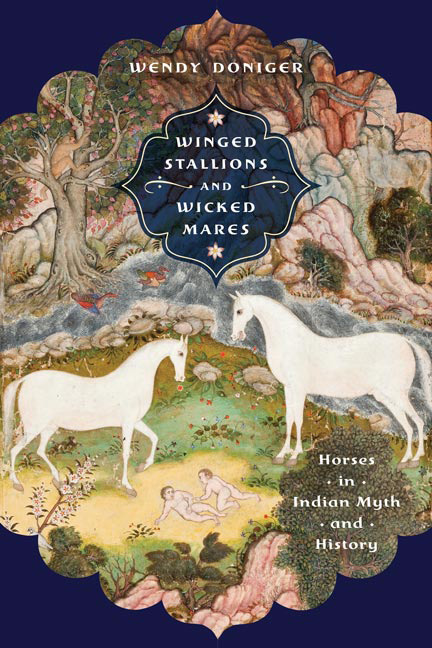
Winged Stallions and Wicked Mares
Horses are not indigenous to India. They had to be imported, making them expensive and elite animals. How then did Indian villagers—who could not afford horses and often had never even seen a horse—create such wonderful horse stories and brilliant visual images of horses? In Winged Stallions and Wicked Mares, Wendy Doniger, called "the greatest living mythologist," examines the horse’s significance throughout Indian history from the arrival of the Indo-Europeans, followed by the people who became the Mughals (who imported Arabian horses) and the British (who imported thoroughbreds and Walers). Along the way, we encounter the tensions between Hindu stallion and Arab mare traditions, the imposition of European standards on Indian breeds, the reasons why men ride mares to weddings, the motivations for murdering Dalits who ride horses, and the enduring myth of foreign horses who emerge from the ocean to fertilize native mares.
- Annie Dillard · Pilgrim at Tinker CreekEvery time Doniger discusses anything at all, she beautifully tosses in the whole world. She treats it all with subtle wit, broad comedy, and analytical brilliance.
- Ariel Glucklich, Georgetown UniversityLike Doniger’s other works on mythology and history, Winged Stallions and Wicked Mares is astonishingly accomplished in the weaving of mythical narratives into a meaningful depiction of the Indian imagination. But the book is clearly also a work of love by a scholar who has spent most of her life in psychic connection with horses.
- Asian Review of BooksDoniger’s ride through four millennia of Indian legend and folklore is full of sacrificial horses, horse-headed gods, transformations and couplings.
- Journal of the American Oriental SocietyWorth the forty-year wait... Winged Stallions and Wicked Mares seems to be, in a sense, the culmination of Doniger’s career, linking her lifelong passion for horses with Indian history and storytelling. The deep personal connection to both of the subjects is noticeable throughout the book and makes it a pleasure to read.
One of the finest works on the history of animals in South Asia.- Religious Studies Review
Wendy Doniger is Mircea Eliade Distinguished Service Professor Emerita of the History of Religions at the University of Chicago and author of more than forty books, including The Hindus: An Alternative History.
Preface
Acknowledgments
A Note on Translation
1. Horses in Indian Nature and Culture
2. Horses in the Indo-European World but Not in the Indus Valley, 3000 to 1500 BCE
3. Horses in the Vedas, 1500 to 500 BCE
4. Horses and Snakes in the Underworld in the Mahabharata and Ramayana, 300 BCE to 300 CE
5. Horses in the Ocean in the Sanskrit Puranas, 400 to 1400 CE
6. Ashvashastra, the Science of Horses, 200 BCE to 1200 CE
7. Buddhist Horses, 500 BCE to 500 CE
8. Arabian Horses and Muslim Horsemen, 500 to 1800 CE
9. Equestrian Epics and Mythic Mares, 600 to 2000 CE
10. Horses of the British Raj, 1700 to 1900 CE
11. Horse Myths and Rituals in the Absence of Horses, 1800 to 2000 CE
12. Horses in Modern India, 1900 to 2020 CE
13. The Gift Horse
Notes
Bibliography
Index

