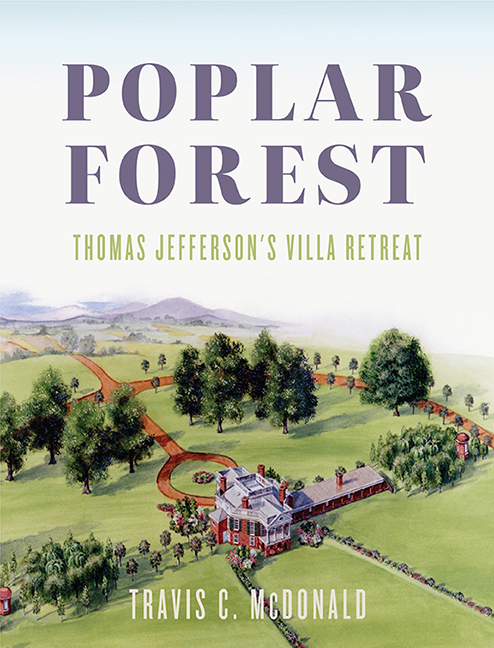
Poplar Forest
Thomas Jefferson's Villa Retreat
Travis C. McDonald
subjects:
Poplar Forest is one of two personal residences that Thomas Jefferson designed for himself, the other being Monticello. Jefferson’s wife, Martha Wayles Skelton Jefferson, inherited the land—originally a 6,861-acre parcel—at her father’s death in 1773, but Jefferson did not begin construction on the house until 1806, and at his death in 1826, he was still working on his little "getaway." Despite its audacious design—it was the first documented octagonal residence in America—and the fact that it is one of the very few extant Jeffersonian structures, Poplar Forest is not nearly so well-known today as its sibling seventy miles to the northeast. Undoubtedly, this is due in large part to its more remote location in Bedford County. Additionally, the house remained in private hands until 1984.
Travis McDonald situates the site in its rightful position as a historically important Virginia house, and he documents its story as central to Jefferson’s life and approach to architecture, including details of the enslaved community at his western retreat. This new, informed account will appeal to architectural historians and visitors to the villa retreat, as well as to those interested in Jefferson’s work and legacy.
- Andrew J. O'Shaughnessy, University of Virginia, author of The Illimitable Freedom of the Human Mind: Thomas Jefferson's Idea of a UniversityIn Poplar Forest: Thomas Jefferson’s Villa Retreat, Travis C. McDonald demonstrates that, even if he had never entered politics, Jefferson would be regarded as one of the greatest pioneer architects in early America. Here, in this work of a lifetime, McDonald has produced a definitive study of Jefferson’s retirement retreat, Poplar Forest. Like so much else in Jefferson’s life, McDonald reveals that his retirement villa was fraught with contradictions, with much of the skilled workmanship being conducted by his unacknowledged African American sons and extended family. It is at the same time a work of greatness.
McDonald's book recounts the remarkable story of Jefferson and Poplar Forest in clear, well-organized prose. McDonald takes a bewildering array of sources, including the minutiae of construction details, and weaves a story that is fascinating, informative, and never boring.- Buildings & Landscapes
Poplar Forest is a gem of a building with a long history as a site of slavery, as one of Jefferson’s essays in architecture, and as a restoration project. McDonald’s book chronicles the restoration in impressive detail and recounts the long campaign of architectural investigation, archaeology, landscape study, and documentary research that made it possible. . . Overall, Poplar Forest is a benchmark of the restoration of Jefferson’s Poplar Forest. It takes measure of the three-decade-long project and reports what is new from the historical record, the history of the building, and the process of bringing it into the present. McDonald has revealed the many reasons Poplar Forest is historically significant and how it now stands as a landmark of historic preservation as well.- Arris
- Journal of the Society of Architectural HistoriansBy closely examining one of Jefferson’s architectural works—in this case Poplar Forest, which McDonald calls Jefferson’s most private building—it offers a deeper understanding of the man’s private self as well as his architecture . . . It encompasses much of Jefferson’s education as an architect and builder, his underlying theories about domestic architecture, and the design and construction of Monticello, Poplar Forest, and the University of Virginia. The author delves into the concept of a retreat in the early nineteenth century and shows how Jefferson used Poplar Forest after he finally retired from public life in 1809. McDonald also interweaves references to many of the people who built Poplar Forest, both free and enslaved; these include the enslaved joiner John Hemmings, who was the half brother of Sally Hemings and produced most of Poplar Forest’s windows, doors, and neoclassical ornamentation. The result is a work that expands beyond Poplar Forest into a comprehensive exploration of Jefferson’s domestic architecture.
Travis C. McDonald is the director of architectural restoration at Poplar Forest.
List of Illustrations
Preface
Acknowledgments
Introduction
1. The Retreat
2. Thomas Jefferson’s Education as Architect and Builder
3. Designing a Retreat
4. The Construction Saga
5. Landscapes of Use and Ornament
6. Retired Life at Poplar Forest
7. A Retirement Hobby
Epilogue
Afterword: Jefferson in Our Time
Appendix A: Chronology
Appendix B: Jeffersonian Elements and Materials
Appendix C: Jefferson’s Typology of Octagon Designs
Notes
Bibliography
Illustration Credits
Index
Preface
Acknowledgments
Introduction
1. The Retreat
2. Thomas Jefferson’s Education as Architect and Builder
3. Designing a Retreat
4. The Construction Saga
5. Landscapes of Use and Ornament
6. Retired Life at Poplar Forest
7. A Retirement Hobby
Epilogue
Afterword: Jefferson in Our Time
Appendix A: Chronology
Appendix B: Jeffersonian Elements and Materials
Appendix C: Jefferson’s Typology of Octagon Designs
Notes
Bibliography
Illustration Credits
Index

