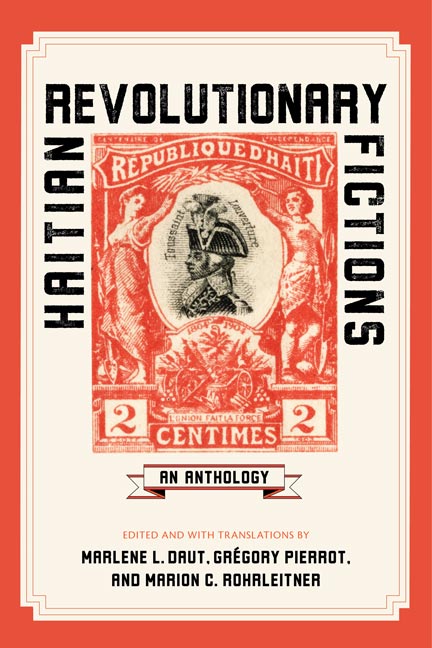
Haitian Revolutionary Fictions
An Anthology
Edited and with translations by Marlene L. Daut, Grégory Pierrot, and Marion C. Rohrleitner
Series:
subjects:
The Haitian Revolution (1791–1804) was the first antislavery and anticolonial uprising led by New World Africans to result in the creation of an independent and slavery-free nation state. The momentousness of this thirteen-year-long war generated thousands of pages of writing. This anthology brings together for the first time a transnational and multilingual selection of literature about the revolution, from the beginnings of the conflicts that resulted in it to the end of the nineteenth century.
With over two hundred excerpts from novels, poetry, and plays published between 1787 and 1900, and depicting a wide array of characters including, Anacaona, Makandal, Boukman, Toussaint Louverture, Jean-Jacques Dessalines, and Henry Christophe, this anthology provides the perfect classroom text for exploring this fascinating revolution, its principal actors, and the literature it inspired, while also providing a vital resource for specialists in the field. This landmark volume includes many celebrated authors—such as Alexandre Dumas, Victor Hugo, Heinrich von Kleist, Alphonse de Lamartine, William Wordsworth, Harriet Martineau, and William Edgar Easton—but the editors also present here for the first time many less-well-known fictions by writers from across western Europe and both North and South America, as well as by nineteenth-century Haitian authors, refuting a widely accepted perception that Haitian representations of their revolution primarily emerged in the twentieth century. Each excerpt is introduced by contextualizing commentary designed to spark discussion about the ongoing legacy of slavery and colonialism in the Americas. Ultimately, the publication of this capacious body of literature that spans three continents offers students, scholars, and the curious reader alike a unique glimpse into the tremendous global impact the Haitian Revolution had on the print culture of the Atlantic world.
New World Studies
- Deborah Jenson, Duke University, coeditor of Poetry of Haitian IndependenceA brilliant collection—readable, comprehensive, scholarly—and just the thing for a time in which teaching by regional/linguistic canon boundaries is increasingly out of step with scholarly knowledge and ethical frameworks to dehegemonize and desegregate humanistic traditions.
- Cécile Accilien, Kennesaw State University, author of Rethinking Marriage in Francophone African and Caribbean LiteraturesBound to become one of the most important works in the fields of Haitian studies, transatlantic studies, and Caribbean history. While there are a number of books, including new edited versions of novels, that focus on the Haitian Revolution, there is no other anthology that brings together such a large number of varied texts and provides such detailed and comprehensive analysis of this period.
- Kaiama L. Glover, Barnard CollegeHaitian Revolutionary Fictions is a generous offering to its readers, an invitation to see more clearly the stakes of representing Black demands for freedom in a world that sought – and fought mightily – to deny such radical vision. The literary, in this volume, is shown to offer a unique prism through which to peer into the past, to allow for visceral encounters with the stories and ideologies that surrounded Haitian independence across time and space, language and genre. With elegance and true insight the editors of this exceptional anthology have crafted what is sure to be a reference in the field of Haitian Studies, of great use to researchers and students alike. The volume's careful presentation of its vast corpus is indeed a testament to Daut, Pierrot, and Rohrleitner's passion and erudition, to their certain faith in the worlds of scholarship their work encourages us to imagine.
- Trinidad Express[A] groundbreaking collection of 18th- and 19th-century fiction, poetry, and drama inspired by the Haitian Revolution. Two hundred excerpts, from texts originally written in multiple languages, show how generations of writers tackled the themes and characters of one of the defining events of modern history. Celebrated authors like Alexandre Dumas and William Wordsworth mingle with less famous contemporaries from Europe, North and South America, and Haiti itself.
- Nineteenth Century French StudiesTaken together, the anthology’s introduction, comprehensive scholarly notices, and translations make for a thorough, rigorous treatment of the vast corpus that is eminently useable. It will be essential reading for students, teachers and researchers alike.
Marlene L. Daut is Professor of African Diaspora Studies at the University of Virginia and author of Tropics of Haiti: Race and the Literary History of the Haitian Revolution in the Atlantic World, 1789-1865. Grégory Pierrot is Associate Professor of English at the University of Connecticut, Stamford, and author of The Black Avenger in Atlantic Culture. Marion C. Rohrleitner is Associate Professor of English at the University of Texas, El Paso, and coeditor of Dialogues across Diasporas: Women Writers, Scholars, and Activists of Africana and Latina Descent in Conversation.
Acknowledgments
Introduction: A World of Haitian Revolutionary Fictions, by Marlene L. Daut
Editorial Note
A Comical Dialogue between Sawney and Bonaparte (ca. 1803-1805)
A Poetical Epistle to the King of Hayti (1817)
Dessalines, Tyrant of the Blacks and Murderer of the Whites in Saint-Domingue: A Canvas from the Gallery of Political Monsters
Bug Jargal: A Historical Romance from the Times of the Negro Rebellion in Saint-Domingue... after Victor Hugo
The Mulatta, as Virtuous as Any White Woman, a Potential Sequel to The Negro Equaled by Few Whites
The Eighteen Adventures of Citizen Cacambeau
The Haïtiade, Poem in Eight Cantos
The Revolutionary Philanthropist; or, Hecatomb in Haiti
Sambo’s Song: On Going to Hayti (ca. 1830s)
The Father and Daughter (1836)
Ode to His Majesty Charles X on the Emancipation of Saint Domingue
Zelica, the Creole (1820)
Idylls and Songs; or, Poetical Essays in Creole
Ode on the Insurrection of the Slaves at St. Domingo (1796)
Dramatic Proverb (Proverbe dramatique) (1836)
Biographical Sketches—Toussaint Louverture (1854)
Selected Works (Oeuvres choisies) (1805)
Christophe, King of Hayti (1821)
The Massacres in St. Domingue: Historical Events
The Red Bridge (Le Pont rouge) (1881)
Monbars, the Exterminator; or, The Last Freebooters
The Macandal: Episode from the Insurrection of the Blacks in Saint-Domingue
The Black War: Memories of Saint-Domingue
Erménie de Boissondeuil: A Historical Novel Dedicated to Mothers
A Tale of St. Domingo (1833)
The Farmers' Three Daughters (1822)
Nights at Sea; or, Sketches of Naval Life during the War (1838)
Oxiane; or, The Revolution in Saint-Domingue (Oxiane; ou, La révolution de Saint-Domingue) (1826)
The Black Head (La Tête noire) (1828-29)
Defense of Crête-à-Pierrot (March 1802) (Défense de la Crête-à-Pierrot [Mars 1802]) (1881)
The Chevalier of Saint-Georges (Le Chevalier de Saint Georges) (1840)
Adonis; or, The Good Negro (Adonis; ou, Le bon nègre) (1799)
Stella (1859)
Collection of Poetry from a Colonist from Saint-Domingue (Recueil de poésies d’un colon de Saint Domingue) (1802)
Félix and Léonore; or, The Unfortunate Colonists (Félix et Léonore; ou, Les colons malheureux) (1801)
Bug-Jargal, Drama in Seven Tableaus, Drawn from the Novel of Victor Hugo (Bug-Jargal, drame en sept tableaux tiré du roman de Victor Hugo) (1881)
General Liberty; or, The Colonists in Paris (La Liberté générale; ou, Les colons à Paris) (1796)
Ephraïm; or, The Young Israelite (Éphraïm; ou, Le jeune Israélite) (1825)
Memories: The Negro Slave Trade (Souvenirs: La traite des Nègres) (1851)
Avenia; or, A Tragical Poem (1805)
The True Story of Makandal (Makandal, histoire véritable) (1787)
Hermésine; or, The Recluse: By Lettre de Cachet (Hermésine; ou, La Recluse: Par lettre de cachet) (1823)
Song of Bug Jargal (O Canto de Bug Jargal) (ca. 1860s)
The Life of a Sailor (1832)
Néhri, Leader of the Haitian People (Néhri, chef des Haytiens) (1819)
The King’s Hunting Party (La Partie de chasse du roi) (1820)
Introduction: A World of Haitian Revolutionary Fictions, by Marlene L. Daut
Editorial Note
A Comical Dialogue between Sawney and Bonaparte (ca. 1803-1805)
A Poetical Epistle to the King of Hayti (1817)
Dessalines, Tyrant of the Blacks and Murderer of the Whites in Saint-Domingue: A Canvas from the Gallery of Political Monsters
Bug Jargal: A Historical Romance from the Times of the Negro Rebellion in Saint-Domingue... after Victor Hugo
The Mulatta, as Virtuous as Any White Woman, a Potential Sequel to The Negro Equaled by Few Whites
The Eighteen Adventures of Citizen Cacambeau
The Haïtiade, Poem in Eight Cantos
The Revolutionary Philanthropist; or, Hecatomb in Haiti
Sambo’s Song: On Going to Hayti (ca. 1830s)
The Father and Daughter (1836)
Ode to His Majesty Charles X on the Emancipation of Saint Domingue
Zelica, the Creole (1820)
Idylls and Songs; or, Poetical Essays in Creole
Ode on the Insurrection of the Slaves at St. Domingo (1796)
Dramatic Proverb (Proverbe dramatique) (1836)
Biographical Sketches—Toussaint Louverture (1854)
Selected Works (Oeuvres choisies) (1805)
Christophe, King of Hayti (1821)
The Massacres in St. Domingue: Historical Events
The Red Bridge (Le Pont rouge) (1881)
Monbars, the Exterminator; or, The Last Freebooters
The Macandal: Episode from the Insurrection of the Blacks in Saint-Domingue
The Black War: Memories of Saint-Domingue
Erménie de Boissondeuil: A Historical Novel Dedicated to Mothers
A Tale of St. Domingo (1833)
The Farmers' Three Daughters (1822)
Nights at Sea; or, Sketches of Naval Life during the War (1838)
Oxiane; or, The Revolution in Saint-Domingue (Oxiane; ou, La révolution de Saint-Domingue) (1826)
The Black Head (La Tête noire) (1828-29)
Defense of Crête-à-Pierrot (March 1802) (Défense de la Crête-à-Pierrot [Mars 1802]) (1881)
The Chevalier of Saint-Georges (Le Chevalier de Saint Georges) (1840)
Adonis; or, The Good Negro (Adonis; ou, Le bon nègre) (1799)
Stella (1859)
Collection of Poetry from a Colonist from Saint-Domingue (Recueil de poésies d’un colon de Saint Domingue) (1802)
Félix and Léonore; or, The Unfortunate Colonists (Félix et Léonore; ou, Les colons malheureux) (1801)
Bug-Jargal, Drama in Seven Tableaus, Drawn from the Novel of Victor Hugo (Bug-Jargal, drame en sept tableaux tiré du roman de Victor Hugo) (1881)
General Liberty; or, The Colonists in Paris (La Liberté générale; ou, Les colons à Paris) (1796)
Ephraïm; or, The Young Israelite (Éphraïm; ou, Le jeune Israélite) (1825)
Memories: The Negro Slave Trade (Souvenirs: La traite des Nègres) (1851)
Avenia; or, A Tragical Poem (1805)
The True Story of Makandal (Makandal, histoire véritable) (1787)
Hermésine; or, The Recluse: By Lettre de Cachet (Hermésine; ou, La Recluse: Par lettre de cachet) (1823)
Song of Bug Jargal (O Canto de Bug Jargal) (ca. 1860s)
The Life of a Sailor (1832)
Néhri, Leader of the Haitian People (Néhri, chef des Haytiens) (1819)
The King’s Hunting Party (La Partie de chasse du roi) (1820)

