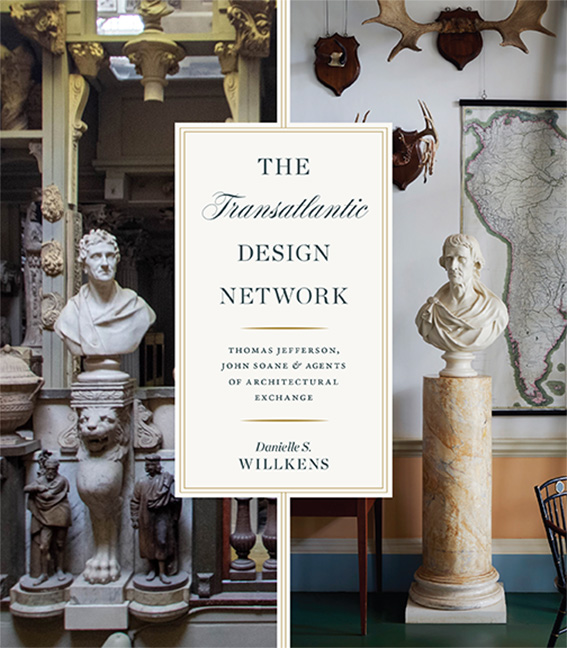
The Transatlantic Design Network
Thomas Jefferson, John Soane, and Agents of Architectural Exchange
Danielle S. Willkens
subjects:
awards:
Architectural Book Awards, (2025, Runner-up)
Tracing the mutual influence of great architects of the eighteenth century on both sides of the Atlantic
Although a good deal has been written about the voluminous intellectual exchange between Europe and the Americas in the eighteenth century across various humane disciplines, no study to date has focused on architectural culture, despite the fact that numerous Europeans made their way across the Atlantic to design some of America’s most important buildings. In this groundbreaking work, Danielle Willkens authoritatively fills that gap, defining and expounding the “transatlantic design network” of mainly British and American individuals that included Thomas Jefferson, the architect John Soane, and Maria Cosway, an acclaimed painter, musician, composer, and educator who maintained a lifelong correspondence with both Jefferson and Soane.
Willkens places Jefferson’s and Soane’s famous homes in a historical and aesthetic context that extends beyond their respective renown as national shrines. She shows how, contrary to their reputations, neither represents the product of a singular architectural vision. The contributions of other architects, designers, philosophers, and friends have been effectively effaced from both Monticello and the Soane House. Willkens here corrects the record, mapping the influence of this crucial hidden network on architecture and aesthetics on both sides of the Atlantic.
Shifting the typical discussion of architectural history from buildings to the people who influenced those buildings, this book makes a substantial contribution to the field. The Transatlantic Design Network contains much that is new and worthy. I learned a great deal.- Mark Reinberger, University of Georgia
Both sweeping and intricate, Danielle Willkens’s The Transatlantic Design Network is a fascinating and insightful account of American architecture in its formative years. Full of remarkable new information about the complex interconnections and interactions between European and American architects and artists, Willkens demonstrates how European forms influenced American visual culture.- Susan R. Stein, Senior Curator, Monticello
- ArrisEnjoyable and accessible, making it a good resource for both research and teaching.
- Journal of the Society of Architectural HistoriansWillkens uses the lives and works of three people—Jefferson, a son of a Virginia plantation owner who was born into a colonial society largely defined by slavery and tobacco; John Soane, an English architect and fourth son of a bricklayer; and Maria Cosway, an English artist and the daughter of a successful inn owner in Italy who catered to wealthy English travelers—to represent the larger eighteenth-and early nineteenth-century personal connections that helped to transmit architectural knowledge and expectations . . . The sketches of their lives and, especially for Jefferson and Soane, the comparisons of their personal domestic architecture are compelling. Willkens reveals how these far-flung designers and tastemakers of the late eighteenth and early nineteenth centuries were all responding to international trends. She also shows how the information passed among the members of this informally connected group of designers was one-sided. Design ideas were clearly moving from Europe to North America.
Danielle S. Willkens is Associate Professor of Architecture at the Georgia Institute of Technology.

