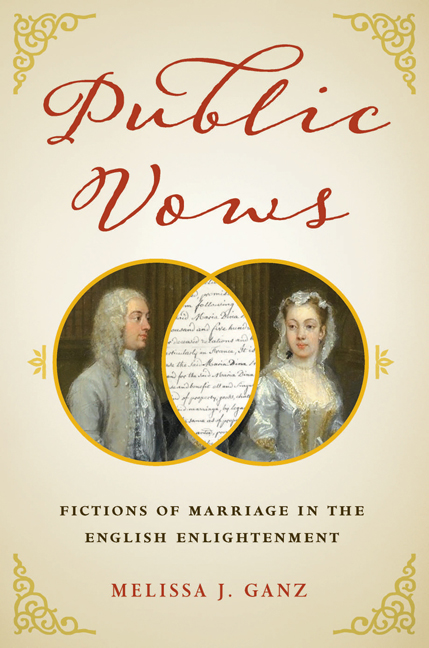
Public Vows
Walker Cowen Memorial Prize, (2018, Winner)
In eighteenth-century England, the institution of marriage became the subject of heated debates, as clerics, jurists, legislators, philosophers, and social observers began rethinking its contractual foundation. Public Vows argues that these debates shaped English fiction in crucial and previously unrecognized ways and that novels, in turn, played a central role in the debates.
Like many legal and social thinkers of their day, novelists such as Daniel Defoe, Samuel Richardson, Frances Burney, Eliza Fenwick, and Amelia Opie imagine marriage as a public institution subject to regulation by church and state rather than a private agreement between two free individuals. Through recurring scenes of infidelity, fraud, and coercion as well as experiments with narrative form, these writers show the practical and ethical problems that result when couples attempt to establish and dissolve unions simply by exchanging consent. Even as novelists seek to shore up the legal regulation of marriage, however, they contest the specific forms that these regulations take.
In recovering novelists’ engagements with the nuptial controversies of the Enlightenment, Public Vows challenges longstanding accounts of domestic fiction as contributing to sharp divisions between public and private life and as supporting the traditional, patriarchal family. At the same time, the book counters received views of law and literature, highlighting fiction’s often simultaneous affirmations and critiques of legal authority.
- Susan S. Lanser, Brandeis University, author of The Sexuality of History: Modernity and the Sapphic, 1565-1830Melissa Ganz adds a crucial new dimension to our understanding of fictional marriage plots and to the legal debates with which they are intertwined. Engagingly written and impeccably researched, Public Vows makes a new case for the importance of fiction as a testing ground for the status of marriage law as a feminist concern.
- Simon Stern, University of Toronto, editor of William Blackstone’s Commentaries on the Laws of England, Book II: Of the Rights of ThingsGanz provocatively reimagines the relations between consent and coercion, law and equity, and public and private, showing how eighteenth-century writings offer startlingly prescient anticipations of contemporary problems.
- SEL Studies in English Literature[W]ell-situated in both secondary and legal scholarship, before moving on to offer attractive, well-supported readings of Defoe, Richardson, Frances Burney, and Amelia Opie.... A particular strength of the book is Ganz's skill at tracing the edges of apparently radical attitudes. Thoughtful people are rarely in one mind about anything, let alone something so able to provoke contesting thoughts as marriage. It is a great strength of Ganz's study that she is so equably open to that.
- Women's WritingThis is a highly significant and valuable book. It should be required reading not just for students and academics studying the development of the court- ship/marriage novel but for anyone seeking to understand the institution of mar- riage, including how its legal and economic aspects adversely – and disproportionately – affected women. It also confirms the position of the novel as a locus of active participation in the debates that shaped the long eight- eenth century. A worthy winner of the Walker Cowen Prize and an indispensable work of scholarship.
Melissa J. Ganz is Assistant Professor of English at Marquette University.

