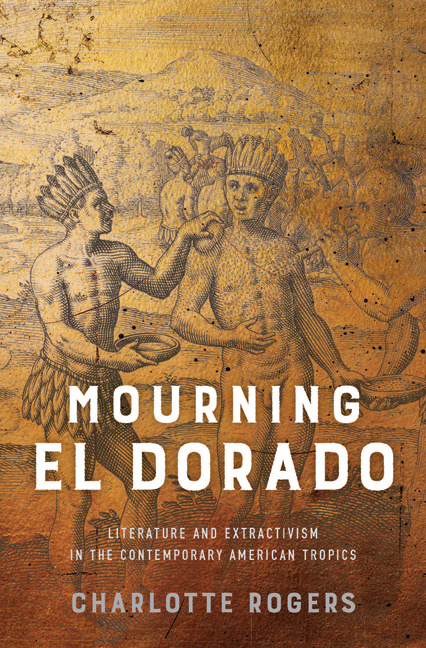
Mourning El Dorado
Best Amazonia Studies Book Prize, Latin American Studies Association (2020, Commended)
What ever happened to the legend of El Dorado, the tale of the mythical city of gold lost in the Amazon jungle? Charlotte Rogers argues that El Dorado has not been forgotten and still inspires the reckless pursuit of illusory wealth. The search for gold in South America during the colonial period inaugurated the "promise of El Dorado"—the belief that wealth and happiness can be found in the tropical forests of the Americas. That assumption has endured over the course of centuries, still evident in the various modes of natural resource extraction, such as oil drilling and mining, that characterize the region today.
Mourning El Dorado looks at how fiction from the American tropics written since 1950 engages with the promise of El Dorado in the age of the Anthropocene. Just as the golden kingdom was never found, natural resource extraction has not produced wealth and happiness for the peoples of the tropics. While extractivism enriches a few outsiders, it results in environmental degradation and the subjugation, displacement, and forced assimilation of native peoples. This book considers how the fiction of five writers—Alejo Carpentier, Wilson Harris, Mario Vargas Llosa, Álvaro Mutis, and Milton Hatoum—criticizes extractive practices and mourns the lost illusion of the forest as a place of wealth and happiness.
- Fabienne Viala, University of Warwick, author of The Post-Columbus Syndrome: Identities, Cultural Nationalism and Commemorations in the Caribbean"The five novels discussed in this study shed a brand new light on the legacies of the myth of El Dorado in Latin American literatures. Rogers goes beyond the idea that the legend of El Dorado was debunked by the Enlightenment and demonstrates that there is an obvious link between colonial and contemporary times. This is a strong line of investigation which resonates with the most recent debates in Latin American scholarship."
- CHOICERogers (Spanish, Univ. of Virginia) presents manifestations of the illusionary perception and quest for emotional and monetary riches through the removal of resources in the tropical forest as seen in works by five Latin American writers: Alejo Carpentier's Los pasos perdidos (1953), Wilson Harris's The Secret Ladder (1963), Mario Vargas Llosa's La casa verde (1966), Álvaro Mutis's La nieve del almirante (1986), and Milton Haloum's Órfãos do Eldorado (2008).... Highly recommended.
- Antonio Ortega Santos, University of GranadaThis is a text of enormous value because it supports a dialogue between the texts proposed for review with multiple references to novels of the tropics; it is a text with an enormous wealth of references that discusses how capitalist modernity used and managed El Dorado as a horizon of utopia from which to legitimize the process of destruction of tropical ecosystems. It remains only to congratulate the author and to continue to follow the narrative paths she shows us, with a text that should be a reference for future research in cultural studies and environmental history.
Charlotte Rogers, Assistant Professor of Spanish at the University of Virginia, is the author of Jungle Fever: Exploring Madness and Medicine in Twentieth-Century Tropical Narratives.
1.From Native Legend to Fictional Motif: A Brief Literary History of El Dorado
2. The Lost Steps to El Dorado: Tracing the Transformation of the Venezuelan Landscape in Alejo Carpentier’s Los pasos perdidos
3. 'City of God, City of Gold': Mystical Ecology and Environmental Exploitation in Wilson Harris's The Secret Ladder
4. Trauma in the Tropics: Reconsidering Mario Vargas Llosa’s La casa verde
5. The 'Golden Halo': Adventure and Extractivism in Alvaro Mutis's La Nieve del Almirante
6. Between Encante and Manoa: Creative Mourning and Critical Nostalgia in Milton Hatoum’s Órfãos do Eldorado
Conclusion: Beyond the Promise of El Dorado?

