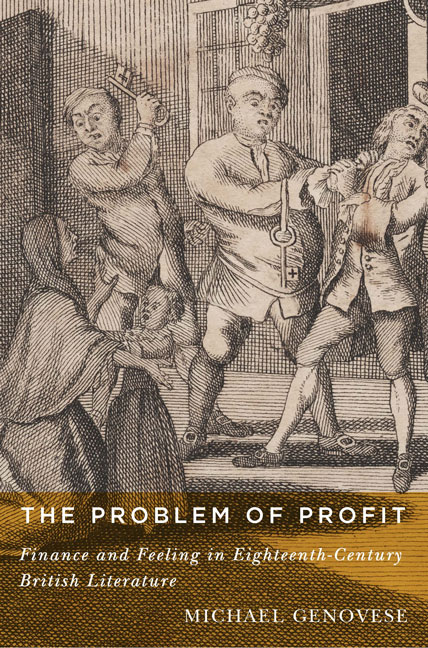
The Problem of Profit
Attacks against the pursuit of profit in eighteenth-century Britain have been largely read as reactions against market activity in general or as critiques of financial innovation. In The Problem of Profit, however, Michael Genovese contends that such rejections of profit derive not from a distaste for moneymaking itself but from a distaste for individualism.
In the aftermath of the late seventeenth-century Financial Revolution, literature linked the concept of sympathy to the public-minded economic ideals of the past to resist the rising individualism of capitalism. This study places literary works at the center of eighteenth-century debates about how to harmonize exchanges of feeling and exchanges of finance, highlighting representations of communitarian, affective profit-making in georgic poetry as well as in the work of Joseph Addison, Daniel Defoe, Richard Steele, Sarah Fielding, Henry Fielding, David Hume, Samuel Johnson, and Laurence Sterne, among others. Investigating commercial treatises, novels, poetry, periodicals, and philosophy, Genovese argues that authors conjured alternatives to private accumulation that might counter the isolating tendencies of impersonal exchange.
However, even as emotional language and economic language arose together in the 1700s, the attendant aspiration to form a communitarian economy in Britain was not fulfilled. By recovering an approach to moneymaking that failed to thrive, The Problem of Profit argues for the relevance of an unfamiliar narrative of capitalistic thought to today’s anxiety over the discord between personal ambition and public good.
- Catherine Ingrassia, Virginia Commonwealth University, author of Authorship, Commerce, and Gender in Early Eighteenth-Century England: A Culture of Paper CreditAn important new perspective full of nuanced readings and well-presented insights.
- SEL Studies in English Literature"[T]he imaginative literature of the eighteenth century often represents trade and tradespeople. Michael Genovese's subtle argument in The Problem of Profit: Finance and Feeling in Eighteenth-Century British Literature is that literature also intervened in the field of economics and frequently assuaged contemporary anxieties about the profit motive and the kinds of human personality it might create or encourage.... This is a fine, important book which organizes a wide range of writings into a perspective on the century which is both intriguing and persuasive."
- The Eighteenth-Century IntelligencerGenovese's The Problem of Profit is well-reasoned and thorough. He has chosen his primary texts judiciously and interspersed other texts in each chapter to demonstrate concerns about profit and profit-making in the period. The notes are copious, detailed, and informative.
- Eighteenth-Century FictionIn this provocative study, Michael Genovese investigates the limitations of sympathy through the lens of finance to uncover a trend in eighteenth-century works that contested the dominant forces leading to the formation of capitalist economies.
- Journal of British StudiesThe development of a holistic approach to the question of finance and feeling promises a
more rigorous understanding of the complicated networks of affect and behavior that underpin
individual economic agency. It is against this background that Michael Genovese’s excellent
The Problem of Profit: Finance and Feeling in Eighteenth-Century British Literature appears. By
studying literary writing from a range of genres, Genovese crafts a compelling argument for
the significance of fellow-feeling in the eighteenth-century economic imagination.
Michael Genovese is Assistant Professor of English at the University of Kentucky.
1. People and Profits
2. Organic Commerce, Georgic Sympathy
3. Feeling Paper; or, Giving Credit to British Periodicals
4. The Character of Self-Interest in David Simple and Amelia
5. Writing Off Sensibility in Hume, Johnson, and Sterne
Coda: Finance without Feeling

