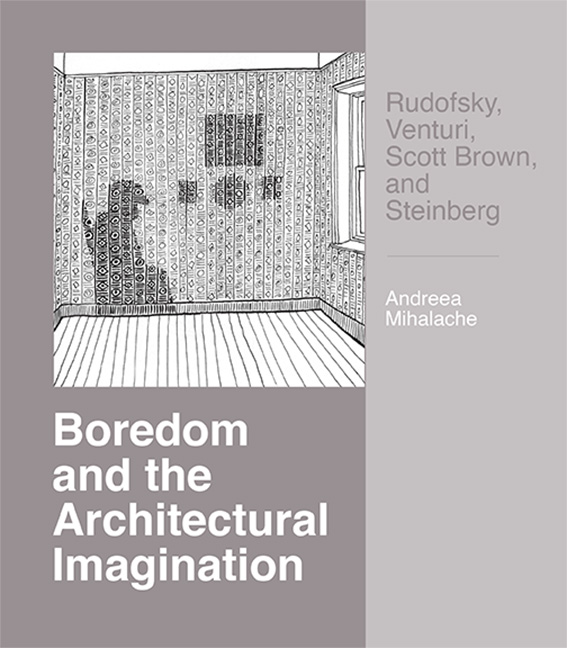
Boredom and the Architectural Imagination
Rudofsky, Venturi, Scott Brown, and Steinberg
Andreea Mihalache
subjects:
Boredom as an impetus for architectural theory and practice
Any theorist or practitioner of architecture must confront, and even be compelled by, boredom. Called ennui, Langeweile, or acedia, boredom is a pressing concern, as the production and obsolescence of images accelerates with new technologies, leaving individuals saturated with information presented in fleeting displays that are easy to produce, easy to delete, and easy to consume. In this innovative book, Andreea Mihalache discusses the work of a quartet of well-known thinkers—designer Bernard Rudofsky, architects Robert Venturi and Denise Scott Brown, and artist Saul Steinberg—who all recognized this form of exhaustion and shallowness as the disease of the modern world. Rudofsky found it in a deeper and more intimate engagement between the human body and its environment. Proclaiming “Less is a bore,” Venturi, and later Scott Brown, explored excess as the remedy to boredom. With detachment and irony, Steinberg mocked the homogenous architecture of the American city. Taken together, Mihalache shows, these four offer a comprehensive view of the alienated relationship of individuals with their world at three different, yet interrelated scales: the body, the building, and the urban space.
A thoroughly researched study, Boredom and the Architectural Imagination is also an eminently quotable work, thanks to Mihalache’s finely tuned statements and precisions, both on her subjects of choice, and on the use of terminology. . . . A deep, rich, yet agile and engaging read, but perhaps not one to engage in a mode of distraction, Boredom and the Architectural Imagination succeeds in contributing to fill a persistent gap in a growing field of academic study almost universally neglected by architectural academia. And this book does it in a seriously entertaining way.- The Plan
Mihalache’s book is timely, and her scholarship is first rate. She uses an original frame to situate her subjects and is able to unpack architectural drawings to reveal what was hidden in plain sight.- Marc Neveu, Arizona State University, coeditor of Architecture's Appeal: How Theory Informs Architectural Praxis
Andreea Mihalache is Associate Professor in the College of Architecture, Arts, and Construction at Clemson University.
Acknowledgments
Prologue: Inviting Time In
Part I. Wandering: Bernard Rudofsky
1. Genealogies of Boredom: A Modern Malaise
2. Critiques of Contemporary Tedium: Boredom and Disprivacy
3. Tactics of Resisting Ennui: Floors and "Our Fingertip Feeling"
Part II. Waiting: Robert Venturi and Denise Scott Brown
4. Genealogies of Boredom: Learning from the Quakers
5. Critiques of Contemporary Tedium: Bob before Denise
6. Tactics of Resisting Ennui: Denise before Bob
Part III. Wondering: Saul Steinberg
7. Genealogies of Boredom: 'A Difference of Altitude'
8. Critiques of Contemporary Tedium: A Fair Position
9. Tactics of Resisting Ennui: Folding Boredom into Daydreaming
Epilogue: Inside Out
Notes
Bibliography
Index
Prologue: Inviting Time In
Part I. Wandering: Bernard Rudofsky
1. Genealogies of Boredom: A Modern Malaise
2. Critiques of Contemporary Tedium: Boredom and Disprivacy
3. Tactics of Resisting Ennui: Floors and "Our Fingertip Feeling"
Part II. Waiting: Robert Venturi and Denise Scott Brown
4. Genealogies of Boredom: Learning from the Quakers
5. Critiques of Contemporary Tedium: Bob before Denise
6. Tactics of Resisting Ennui: Denise before Bob
Part III. Wondering: Saul Steinberg
7. Genealogies of Boredom: 'A Difference of Altitude'
8. Critiques of Contemporary Tedium: A Fair Position
9. Tactics of Resisting Ennui: Folding Boredom into Daydreaming
Epilogue: Inside Out
Notes
Bibliography
Index

