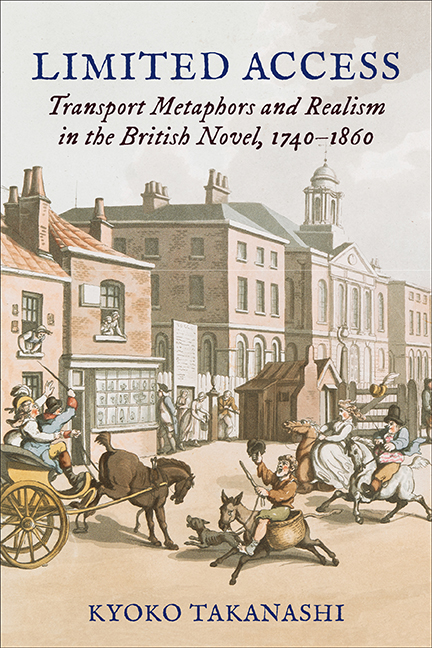
Limited Access
A recurrent trope in eighteenth- and nineteenth-century British fiction compares reading to traveling and asserts that the pleasures of novel-reading are similar to the joys of a carriage journey. Kyoko Takanashi points to how these narratives also, however, draw attention to the limits of access often experienced in travel, and she demonstrates the ways in which the realist novel, too, is marked by issues of access both symbolic and material.
Limited Access draws on media studies and the history of books and reading to bring to life a history of realism concerned with the inclusivity of readers. Examining works by Henry Fielding, Laurence Sterne, Walter Scott, Charles Dickens, William Makepeace Thackeray, and George Eliot, Takanashi shows how novelists employed metaphors of transport to constantly reassess what readers could and could not access. She gives serious attention to marginalized readers figured within the text, highlighting their importance and how writers were concerned about the "limited access" of readers to their novels. Discussions of transport allowed novelists to think about mediation, and, as this study shows, these concerns about access became part of the rise of the novel and the history of realism in a way that literary history has not yet recognized.
- Richard Menke, University of Georgia, author of Literature, Print Culture, and Media Technologies, 1880–1900: Many InventionsA distinctive and genuinely worthwhile contribution to the history of the novel and the theory of literary realism. Sophisticated, ambitious, and innovative, Limited Access should be of interest to those who study, teach, or read eighteenth- and nineteenth-century fiction.
A sophisticated study and a valuable contribution to the history of the novel.- Eighteenth-Century Studies
Limited Access ought to find a wide audience amongst scholars of nineteenth-century media and the novel. Moreover, it will greatly aid anyone concerned with accessibility in the classroom. In its theorizing and foregrounding the contingency of realist representation, Limited Access offers timely tools for helping our students recognize, in the historical foreignness of nineteenth-century realism, an ongoing negotiation between- Victorian Studies
novelists, novels, and readers over historically shifting modes of reading—rather than a transparently mimetic medium often more easily understood by instructors than by students. Takanashi admirably retrains our attention on the collective, interactive enterprise of shared meaning-making definitive of our objects of inquiry and, ultimately, our classrooms.
Kyoko Takanashi is Associate Professor of English at Indiana University South Bend.
Introduction: The Transports of Reading
Delivering Narrative to Consumer-Readers: Staging Inclusion in Fielding's Tom Jones
Noisy Vehicles and Oversensitive Readers: Mis-Communicating Feeling in Sterne's A Sentimental Journey and Smollett's Humphry Clinker
Local History for Distant Readers: Narrative Transmission in Scott's The Tales of My Landlord
Information Overload in Industrial Print Culture: Shortcuts to Knowledge in Dickens' The Pickwick Papers
The "prae-railroadite" and the Railway Generation: Sharing Memories in Thackeray's Vanity Fair
Conclusion: George Eliot and Contingent Access to Literary History
Notes
Bibliography

