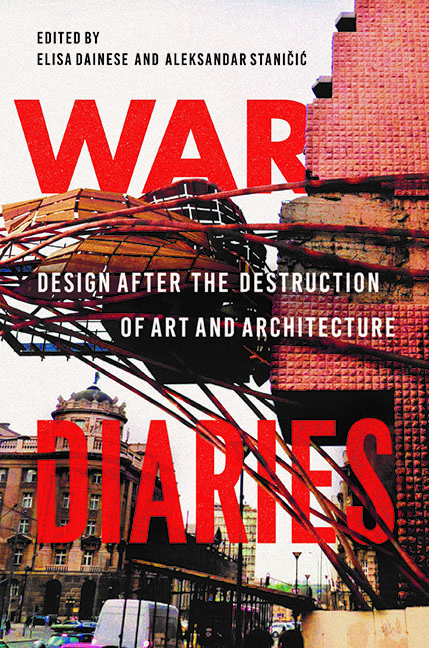
War Diaries
Design after the Destruction of Art and Architecture
Edited by Elisa Dainese. Edited by Aleksandar Stanicic
subjects:
In recent decades, the development of advanced weaponry systems and the instant flow of information have redefined the notion of urban warfare as a local phenomenon with global effects in an increasingly interconnected world. The annihilation of Aleppo and the broadcasted demolitions of Palmyra demonstrate the accelerating politicization of the destruction process. In this timely volume, Elisa Dainese, Aleksandar Staničić, and a broad range of contributors explore the weaponization of architecture—targeted attacks on art and infrastructure meant to destroy not only physical structures but also political unity and cultural memory.
Focusing on regions where planners, architects, and artists are involved in concrete initiatives on the ground, War Diaries looks at complex postwar settings to illuminate design responses to urban warfare and violence against the built environment. The essays discuss creative strategies for rebuilding and restablizing damaged sites, often within the context of continuing animosities; the establishment of design coalitions to work with local communities on reconstruction; the designing of emergency settlements; the development of new and customized strategies for rebuilding diverse parts of the ravaged world; and the teaching of culturally sensitive design practices to architects and urbanists, among many other topics. A much-needed contribution to our understanding of postconflict design, this volume maps the creative approaches that specialists have used to remediate the effects of violence against cities and cultural heritage.
- Emily Gunzburger Makaš, University of North Carolina, Charlotte, author of Urban and National Identities and the Rebuilding of MostarSharing voices across disciplines, this interesting and important collection foregrounds the designer’s role in the political conversations that dominate postconflict work.
War Diaries makes a compelling case for the role of design in enacting more just and sustainable forms of post-conflict reconstruction – not as a panacea but as part of a broader ecology of social, political, and environmental repair. Its provocations and examples point towards an emerging paradigm of reconstructive practice that is grounded in critical reflection, historical understanding, and an ethics of care. For scholars and practitioners grappling with the spatial dimensions of conflict and recovery, the book is an invaluable resource and a catalyst for further research and action.- THE PLAN Journal
Elisa Dainese is Assistant Professor in History and Theory of Architecture at Georgia Tech. Aleksandar Staničić is Assistant Professor of Architecture at Delft University of Technology in the Netherlands.
Foreword
Acknowledgments
Introduction: Critical Themes of Design after Destruction
1. On Urban Postconflict Development: Toward a Practice-Oriented Research Agenda
2. Ivan Štraus: War Diary and Design Intentions of an Architect in Postwar Sarajevo
3. Normalizing War: The Aesthetics of National Resilience
4. Scars of War and Reconstruction in Lebanon
5. "Simple Plans" and Complex Lives: A Dialogue about Planning and Designing Emergency Settlements
6. Designing Emergency Architecture
7. Teaching Culturally Sensitive Design
Conclusion: Reconceptualizing Design after Destruction
Bibliography
Notes on Contributors
Index
Acknowledgments
Introduction: Critical Themes of Design after Destruction
1. On Urban Postconflict Development: Toward a Practice-Oriented Research Agenda
2. Ivan Štraus: War Diary and Design Intentions of an Architect in Postwar Sarajevo
3. Normalizing War: The Aesthetics of National Resilience
4. Scars of War and Reconstruction in Lebanon
5. "Simple Plans" and Complex Lives: A Dialogue about Planning and Designing Emergency Settlements
6. Designing Emergency Architecture
7. Teaching Culturally Sensitive Design
Conclusion: Reconceptualizing Design after Destruction
Bibliography
Notes on Contributors
Index

