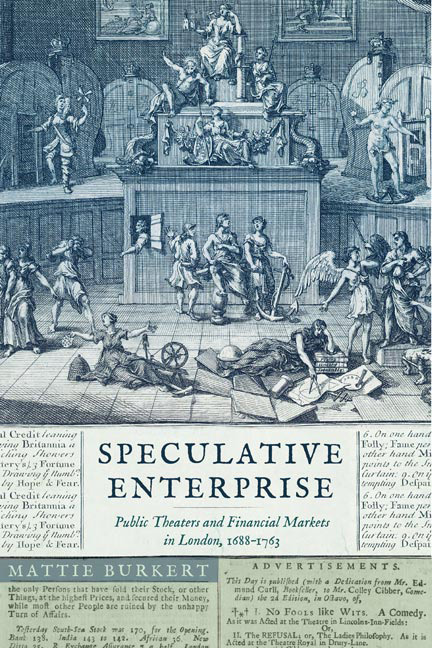
Speculative Enterprise
In the wake of the 1688 revolution, England’s transition to financial capitalism accelerated dramatically. Londoners witnessed the rise of credit-based currencies, securities markets, speculative bubbles, insurance schemes, and lotteries. Many understood these phenomena in terms shaped by their experience with another risky venture at the heart of London life: the public theater. Speculative Enterprise traces the links these observers drew between the operations of Drury Lane and Exchange Alley, including their hypercommercialism, dependence on collective opinion, and accessibility to people of different classes and genders.
Mattie Burkert identifies a discursive "theater-finance nexus" at work in plays by Colley Cibber, Richard Steele, and Susanna Centlivre as well as in the vibrant eighteenth-century media landscape. As Burkert demonstrates, the stock market and the entertainment industry were recognized as deeply interconnected institutions that, when considered together, illuminated the nature of the public more broadly and gave rise to new modes of publicity and resistance. In telling this story, Speculative Enterprise combines methods from literary studies, theater and performance history, media theory, and work on print and material culture to provide a fresh understanding of the centrality of theater to public life in eighteenth-century London.
- John O’Brien, University of Virginia, author of Literature Incorporated: The Cultural Unconscious of the Business Corporation, 1650–1850Burkert demonstrates a new way of understanding the relationship between the theater and the financialization of the early modern economic system, revealing the construction of a new kind of what we might call ‘publicness’—a way of conceptualizing both the theatergoing public and the broader mass of population that this public represented.
- Emily Hodgson Anderson, University of Southern CaliforniaThis lucid, compelling, and highly original study has the rare quality of making novel insights feel familiar. A major contribution to eighteenth-century studies, theater history, and economic history
- Carrie Shanafelt · Eighteenth-Century StudiesAn exceptionally well written book that narrates complex financial events accessibly, drawing from an impressive range of sources, both in theatrical studies and in economic history... Burkert's exploration of eighteenth-century British financial and theatrical history is a tremendously useful contribution to economic humanities that offers a glimpse into the origins of financial manipulations of the modern entertainment industry.
Mattie Burkert is Assistant Professor of English at the University of Oregon.
Introduction: The Theater-Finance Nexus
1. "Virtue Is as Much Debased as Our Money": Generic and Economic Instability in Love’s Last Shift
2. Recoining the Repertory: Prologues, Epilogues, and Crisis
3. Women at the Theater-Finance Nexus: Susanna Centlivre as Playwright-Adventurer
4. Defrauding the Public: Spectacle and Speculation in Steele’s Theatre and The Conscious Lovers
5. "His Title, Not His Play, We Set to Sale": Literary Property in the Aftermath of the South Sea Bubble
Coda: The Theater-Finance Nexus in Later Eighteenth-Century London
Notes
Bibliography
Index

