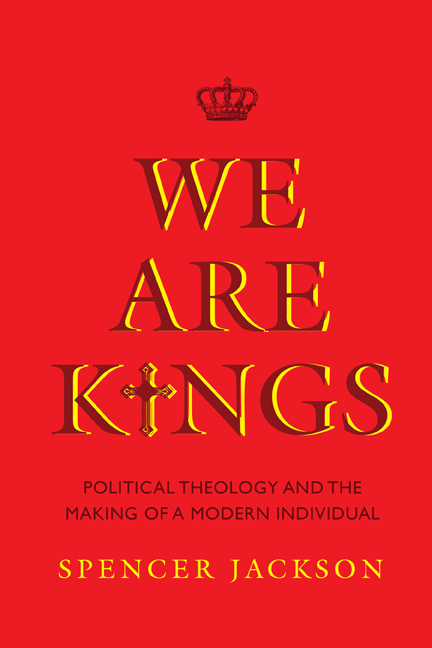
We Are Kings
When British and American leaders today talk of the nation—whether it is Boris Johnson, Barack Obama, or Donald Trump—they do so, in part, in terms established by eighteenth-century British literature. The city on a hill and the sovereign individual are tropes at the center of modern Anglo-American political thought, and the literature that accompanied Britain’s rise to imperial prominence played a key role in creating them.
We Are Kings is the first book to interpret eighteenth-century British literature from the perspective of political theology. Spencer Jackson returns here to a body of literature long associated with modernity’s origins without assuming that modernity entails a separation of the religious from the profane. The result is a study that casts this literature in a surprisingly new light. From the patriot to the marriage plot, the narratives and characters of eighteenth-century British literature are the products of the politicization of religion, Jackson argues; the real story of this literature is neither secularization nor the survival of orthodox Judeo-Christianity but rather the expansion of a movement beginning in the High Middle Ages to transfer the transcendent authority of the Catholic Church to the English political sphere. The novel and the modern individual, then, are in a sense both secular and religious at once—products of a modern political faith that has authorized Anglo-American exceptionalism from the eighteenth century to the present.
- Sarah Tindall Kareem, UCLA, author of Eighteenth-Century Fiction and the Reinvention of WonderA dazzling, provocative book. In addition to making a new case for the importance of recovering the individual as a crucial concept for interpreting eighteenth-century literature, We Are Kings also makes a bold new contribution to debates about secularization and modernity. Jackson makes an audacious argument for a new Marxist critique of complicity in which he proves himself as adept at analyzing the metrical intricacies of neoclassical couplets as parsing the nuances of novelistic prose.
- Vivasvan Soni, Northwestern University, author of Mourning Happiness: Narrative and the Politics of ModernityAn enormously insightful and forcefully argued work that teaches us to read eighteenth-century novels and forms of subjectivity in fresh ways.
Spencer Jackson is a labor organizer with the American Federation of Teachers (AFT) and an independent scholar.
1. Dryden’s Political Theology and the Making of a Modern Subject
2. The Domestic Novel’s First Heroine: Alexander Pope and the Construction of a National Theological Subject
3. "Beyond What the Crown Itself Can Confer": Clarissa and the Antinomian Heart of the Modern British Subject
4. The Other Side of Discipline: Marriage, Slavery, and the Ambivalent Politics of Maria Edgeworth’s Domestic Subject
Epilogue: An Immanent Language of Change
Bibliography

