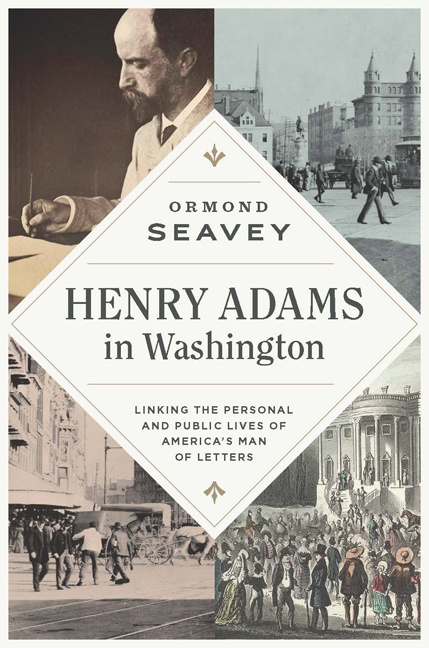
Henry Adams in Washington
A descendent of two U.S. presidents and winner of the Pulitzer Prize, Henry Adams enjoyed a very particular place in American life, not least due to his ancestry. Yet despite his prolific writing in the years between 1877 and 1891, when he lived in Washington, D.C., Adams has somehow slipped into the gap between history and literature. In Henry Adams in Washington, Ormond Seavey integrates the diverse aspects of Adams’s writing, arguing for his placement among the major American writers of the nineteenth century.
Examining Adams’s nine-volume History, which Seavey argues demands renewed literary attention, as well as his two novels, Democracy and Esther, and his biographies of Albert Gallatin and John Randolph of Roanoke, Seavey shows how Adams reveals his own character and personality in his writings, particularly his fondness for the personal rather than the public sphere. As a historian writing in Washington, D.C., Adams surely encountered the expectation that public life takes precedence over the personal; in the execution of both his historical writing and his novels, however, he dwells instead on the personal costs of public life and the diminishment of public figures who lack a fulfilling personal life. Revealing Adams to be a missing link between the essential American writers in the time of Emerson and the modernist writers of the early twentieth century, Seavey shows his novels to be considerations of contemporary political issues while also recognizing the novelistic dimensions in his history and biographies.
- Johhn Kaminski, editor of The Documentary History of the Ratification of the ConstitutionSeavey convincingly argues that neither literary critics nor historians have properly appreciated Adams’s literature and that Adams is incorrectly perceived ‘as a cynical and negative historian.’ To fully appreciate Adams’s writings, Seavey shows that one must understand Adams himself, the times and the place in which he lived, his associates (particularly his family and his wife Clover), and nineteenth-century historiography. A work of great scholarship.
- William Merrill Decker, Oklahoma State University, author of Geographies of Flight: Phillis Wheatley to Octavia ButlerThis deeply informed, vigorously argued, and eloquent book marks a major advance in our understanding of Henry Adams.
- The New YorkerAdams’s life as a Bostonian in Washington, hiding out in the spotlight, is the focus of Ormond Seavey’s Henry Adams in Washington: Linking the Personal and Public Lives of America’s Man of Letters
- Washington Independent Review of BooksSeavey scores high on presenting Adams as a man of letters.
- American Literary HistoryAdams has always been an enigmatic writer. Undeterred by Adams’s irony and obfuscation, Ormond Seavey finds news riches in Adams’s too-often forgotten works written between 1877 and 1891 in his quiet study at his fashionable Lafayette Square address overlooking the White House that his great-grandfather and grandfather once occupied
Ormond Seavey, Professor of English at The George Washington University, is author of Becoming Benjamin Franklin: The Autobiography and the Life.
Chronology, 1796-1918
Preface
Introduction
1. Fiction and History in Washington, D.C.
2. The Mighty Machinery and the Hands on It: Henry Adams’s Washington
3. "No Doubt They All Bore More or Less the Stamp of Boston"
4. Democracy: The Novel as Disguised Autobiography
5. Echoes of Democracy in Henry James
6. Gallatin: The Cosmopolitan Frontiersman Jeffersonian
7. John Randolph: Biography as Satire
8. "History Has Many Cunning Passages"
9. "Could It Take Permanent Political Shape? Could It Give New Life to Religion and Art?"
10. "The Reign of Politics Showed No Sign of Ending"
11. Esther and an Attempted Rescue
12. Conversation, Edward Gibbon, Clover Adams, Ralph Waldo Emerson
Notes
Bibliography
Index

