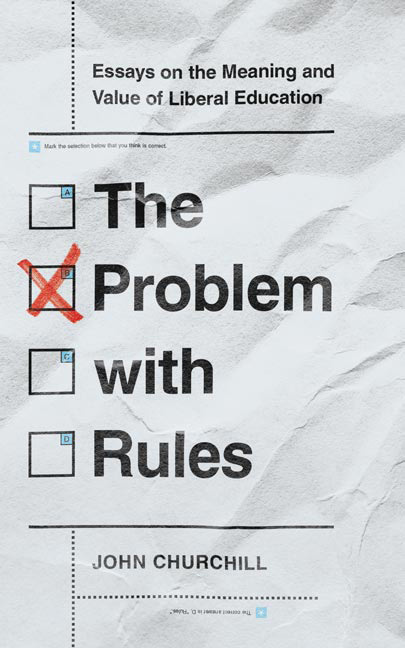
The Problem with Rules
There is a constant drumbeat of commentary claiming that STEM subjects—science, technology, engineering, and math—are far more valuable in today’s economy than traditional liberal arts courses such as philosophy or history. Many even claim that the liberal arts are "under siege" by neoliberal politicians and cost-conscious university administrators. In a forceful response, The Problem with Rules establishes the essential value of the liberal arts as the pedagogical pathway to critical thinking and moral character and argues for more not less emphasis in higher education.
John Churchill asserts that the liberal arts are more than decorative frills. Drawing from the philosophy of Wittgenstein to craft a cogent, inspired argument, Churchill insists on the liberal arts’ indispensable role, providing in this book a clarion call to politicians, university administrators, and all Americans to recognize and actively support and nurture the liberal arts.
- Catherine Berheid, Skidmore College, included in Sociology: Learning Climates That Cultivate Racial and Ethnic DiversityThe field of higher education is currently engaged in a highly contentious debate over the value of a liberal arts education. Churchill wants his readers to consider, to deliberate in his words, the question of the value and the meaning of the liberal arts from a new angle, one which allows for vagueness, uncertainly, and change. His book meets his goal in an elegant and thought-provoking fashion.
- Arkansas Times[The book's] subject is of vital importance to us all, and Churchill makes an engaging and accessible case for the meaning of the liberal arts tradition..... Americans’ receptivity to violence and to authoritarianism seems to have us pointed away from the very foundations of deliberative abilities, which Churchill identifies in part as curiosity, knowledge, imagination, and a tolerance of vagueness. It is a gut-wrenching time. And Churchill’s prescription—that we recommit to cultivating this liberal-arts deliberation—is timelier than ever.
- Arkansas TimesChurchill’s prescription — that we recommit to cultivating this liberal-arts deliberation — is timelier than ever.
- Fred H. Cate, Indiana UniversityChurchill makes a masterful, engaging, and compelling case for the subjects and skills of the liberal arts and their enduring relevance for individuals, society, and democracy.
The late John Churchill was Executive Secretary of Phi Beta Kappa from 2001 to 2016 and Professor of Philosophy at Hendrix College.
Foreword by Hugh O. H. Churchill and Larry R. Churchill
Preface
1. The "Essence" of Liberal Education
2. Wittgenstein on Rules and Its Relevance for Liberal Education
3. Benefits of Liberal Education: Deliberation and the Emergence of Meaning
4. What Is the Liberal Arts Canon and How Is It Justified?
5. Liberal Arts in a Global Context
6. Liberal Arts and Personal Identity
Afterword by Frederick M. Lawrence
Notes
Bibliography

