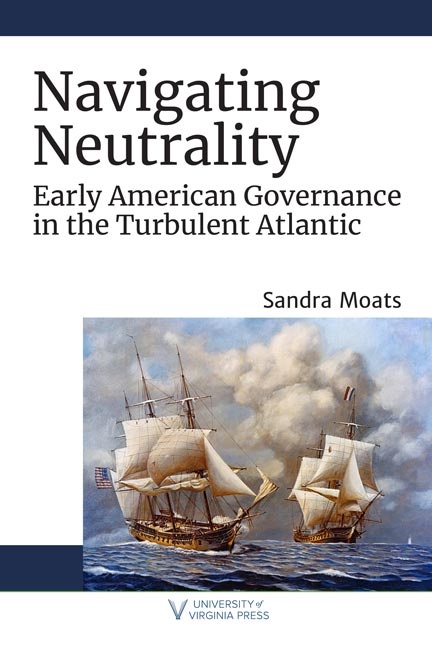
Navigating Neutrality
Early American Governance in the Turbulent Atlantic
Sandra Moats
Series:
subjects:
Navigating Neutrality explores the unexpected role George Washington’s 1793 Neutrality Proclamation played in energizing the U.S. government’s constitutional responsibilities to support and promote America’s commercial and sovereign interests. Designed to avoid warfare as Great Britain and France battled in the Atlantic during the French Revolutionary Wars, neutrality encompassed a wide range of issues, including diplomacy, law, defense, commerce, and domestic politics.
Proclaiming neutrality proved easier than enforcing it. American citizens eagerly accepted lucrative French privateering commissions, and Britain retaliated by attacking American ships, cargos, and sailors. In response, Washington and his cabinet formulated policies to enforce neutrality across all three branches of the government and around the globe. Maritime citizens, stranded in the Caribbean and Mediterranean, especially came to appreciate the government’s rescue efforts. As Sandra Moats shows, enforcing neutrality galvanized all three branches of the nascent U.S. government, serving as a manifesto of the young nation’s quest to be respected in its independence and helping to build a U.S. government capable of supporting its global aspirations.
The Revolutionary Age
- Denver Brunsman, George Washington University, author of The Evil Necessity: British Naval Impressment in the Eighteenth-Century Atlantic WorldClearly written, this book argues that more than a single policy of the Washington administration, neutrality during the French Revolutionary Wars of the 1790s was a guiding principle that helped to build an economically independent and politically sovereign United States. An original and important contribution to our understanding of early American state-building and political development.
Sandra Moats is Professor of History at the University of Wisconsin–Parkside and author of Celebrating the Republic: Presidential Ceremony and Popular Sovereignty, from Washington to Monroe.
List of Illustrations
Acknowledgments
Introduction: "The Mischiefs of Foreign Intrigue"
"Highway Robbery under the Protection of the Law: American Privateers in the Eighteenth-Century Atlantic
"Free Ships Make Free Goods": RevolutionaryExperimentsinNeutrality
"The Contests of European Nations": George Washington and Neutrality
"Americans in Politics": Crafting a Neutral Proclamation
"To Keep This Country in Peace": FrenchViolationsandExecutiveActions
"A Rank Due to the United States":Enforcing Neutrality across the Federal Government
"My Objects Are, to Prevent a War": Enforcing Neutrality across the Globe
Conclusion: "First in Peace": George Washington, Statesman
Notes
Bibliography
Index
Acknowledgments
Introduction: "The Mischiefs of Foreign Intrigue"
"Highway Robbery under the Protection of the Law: American Privateers in the Eighteenth-Century Atlantic
"Free Ships Make Free Goods": RevolutionaryExperimentsinNeutrality
"The Contests of European Nations": George Washington and Neutrality
"Americans in Politics": Crafting a Neutral Proclamation
"To Keep This Country in Peace": FrenchViolationsandExecutiveActions
"A Rank Due to the United States":Enforcing Neutrality across the Federal Government
"My Objects Are, to Prevent a War": Enforcing Neutrality across the Globe
Conclusion: "First in Peace": George Washington, Statesman
Notes
Bibliography
Index

