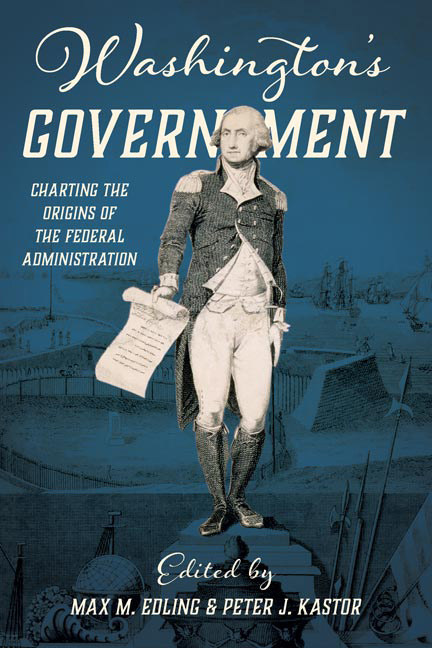
Washington's Government
Washington’s Government shows how George Washington’s administration—the subject of remarkably little previous study—was both more dynamic and more uncertain than previously thought. Rather than simply following a blueprint laid out by the Constitution, Washington and his advisors constructed over time a series of possible mechanisms for doing the nation’s business. The results were successful in some cases, disastrous in others. Yet at the end of Washington’s second term, there was no denying that the federal government had achieved remarkable results. As Americans debate the nature of good national governance two and a half centuries after the founding, this volume’s insights appear timelier than ever.
ContributorsLindsay M. Chervinsky, Iona College * Gautham Rao, American University * Kate Elizabeth Brown, Huntington University * Stephen J. Rockwell, St. Joseph’s College * Andrew J. B. Fagal, Princeton University, * Daniel Hulsebosch, New York University * Rosemarie Zagarri, George Mason University
- Kevin Butterfield, Washington Library at Mount VernonGeorge Washington in 1783 saw a nation desperately in need of "a supreme power to regulate and govern the general concerns of the confederated Republic," a need that was met—on paper—with the Constitution of 1787. This important and insightful volume explores how those paper powers came to be transformed into a functioning federal government, one that could take on the many challenges facing the new American nation.
- Richard R. John, Columbia UniversityWashington’s Government brings together original scholarship on the Washington administration—an important yet oddly neglected topic. The scholarship is fresh and imaginative, and the writing is clear and accessible.
- H-NetWashington’s Government is a welcome addition to the scholarship of both the early republic and American state-building. It demonstrates that the Washington presidency is largely worthy of its "golden halo" because it created a relatively efficient federal government despite the ambiguity of the US Constitution in regard to the day-to-day functionality of its agencies and their officeholders... The contributors to this volume have deftly mined the sources of their respective fields to create essays that are scholarly enough to interest historians and political scientists while still being accessible to undergraduates and history buffs.
- Journal of Southern HistoryCollectively and individually, its chapters offer a significant reinterpretation of 1790s governance. More important, it demonstrates the great benefit of moving beyond the lenses of political culture, party formation, and the transition to democracy to discover "the reality of a Washington administration struggling to create federal institutions that could respond to pressing challenges both numerous and profound"... [A] brilliantly edited, remarkably even, and laser-focused book.
Max M. Edling is Reader in Early American History at King’s College London and author of Perfecting the Union: National and State Authority in the US Constitution.Peter J. Kastor is Samuel K. Eddy Professor of History at Washington University in St. Louis and author of William Clark’s World: Describing America in an Age of Unknowns.
Introduction: Creating the Federal Government
1. George Washington and the Cabinet: The Unlikely Development of an Unintended Institution
2. Washington’s Workforce: Reconstructing the Federal Government at the Moment of Its Creation
3. The Theory and Practice of Federalist Political Economy
4. Creating Interdepartmental Collaboration: Federal Judges, the Remitting Act, and Cooperative State Building
5. Indian Affairs and the Relentless American State
6. "The Next Great Work to Be Accomplished": American Armament Policy
7. From Constitution Making to State Building: The Washington Administration and the Law of Nations
8. The Legislative Output of Congress
Afterword: Reflections on the Political History of the Early Republic
Notes on Contributors
Index

